
Casual Jacket Block
Drafting
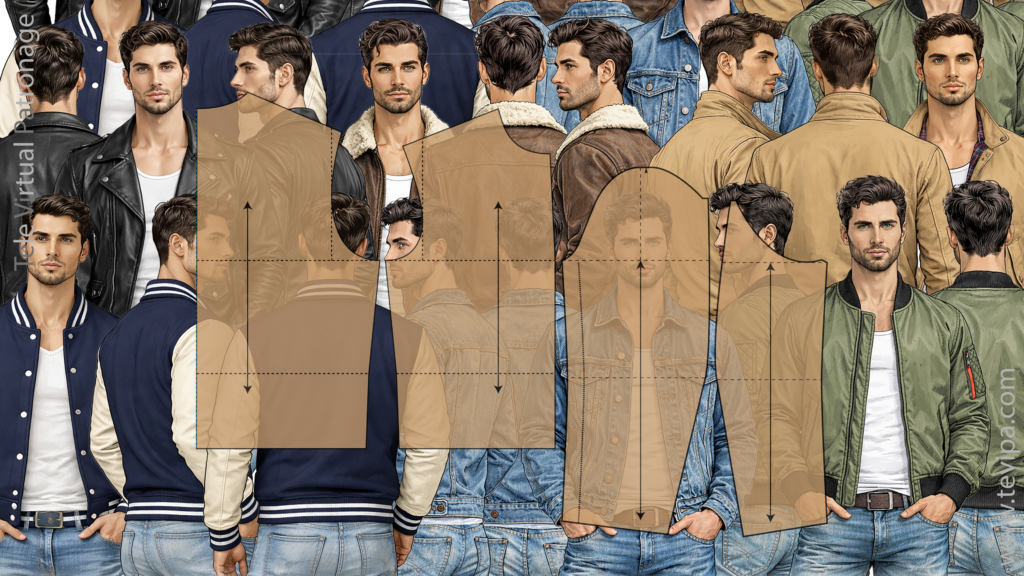
The casual jacket: definition and block foundation
The casual jacket is one of the most versatile garments in contemporary wardrobes. Short, functional, and seemingly simple in construction, it actually relies on a very precise drafting logic that allows it to adapt to multiple styles, ages, and body types.
In this article, we focus exclusively on its foundation: the pattern drafting. With just a few well-chosen measurements and a clear nomenclature, you can build a solid structure from which to develop any variation, from the most classic to the most informal.
This content forms part of a complete system: theoretical foundation and practical application.
Here you will find the required measurements and the key points of the system clearly organized, so you can follow it, understand it, and reproduce it with precision.
With this system, you can draft any casual jacket based primarily on the chest circumference, complemented by a small number of additional measurements such as sleeve length and back length.
In the following articles, we will develop the classification of casual jackets, ease allowances, adaptation to different body types, and pattern grading.
Measurements and proportions
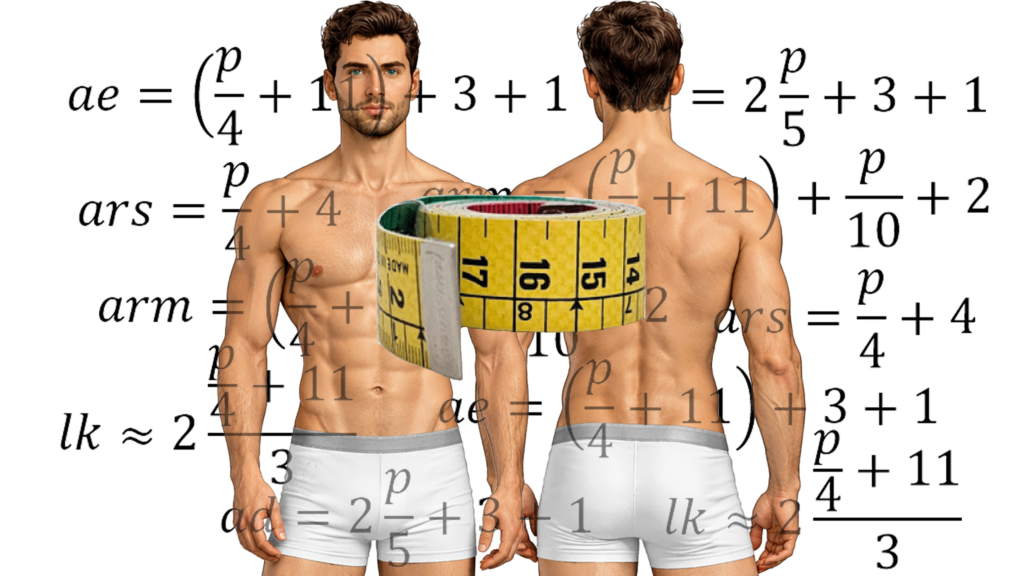
In this section, we analyze the measurements required to draft the casual jacket.
We also explain how to derive them from the half chest circumference.
Body measurements
You take these directly on the client’s body. In many cases, you only take the ones you cannot derive.
Body
Half chest circumference
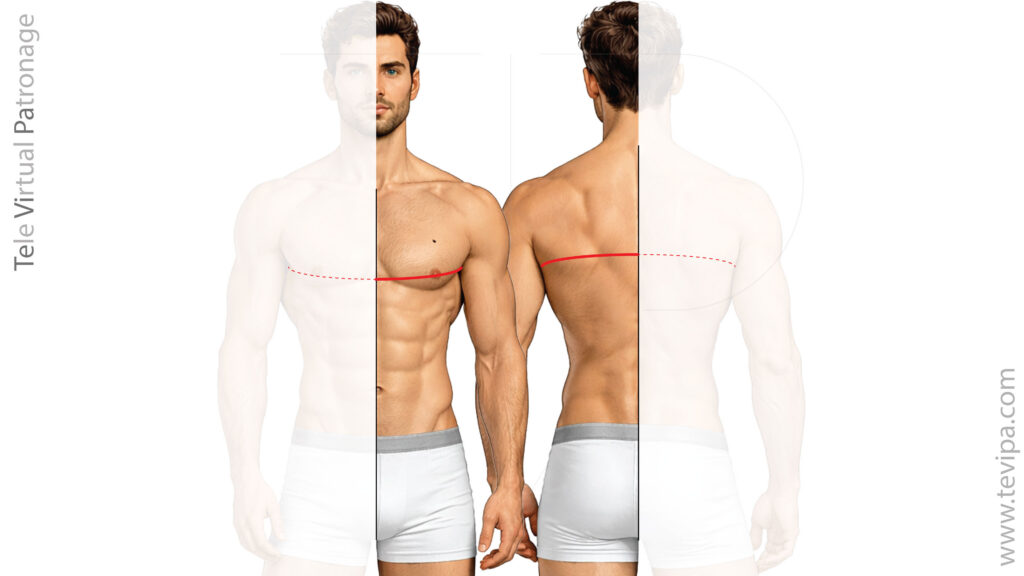
The half chest circumference defines the main measurement and the sizing reference for the casual jacket.
You need this measurement.
Armhole length
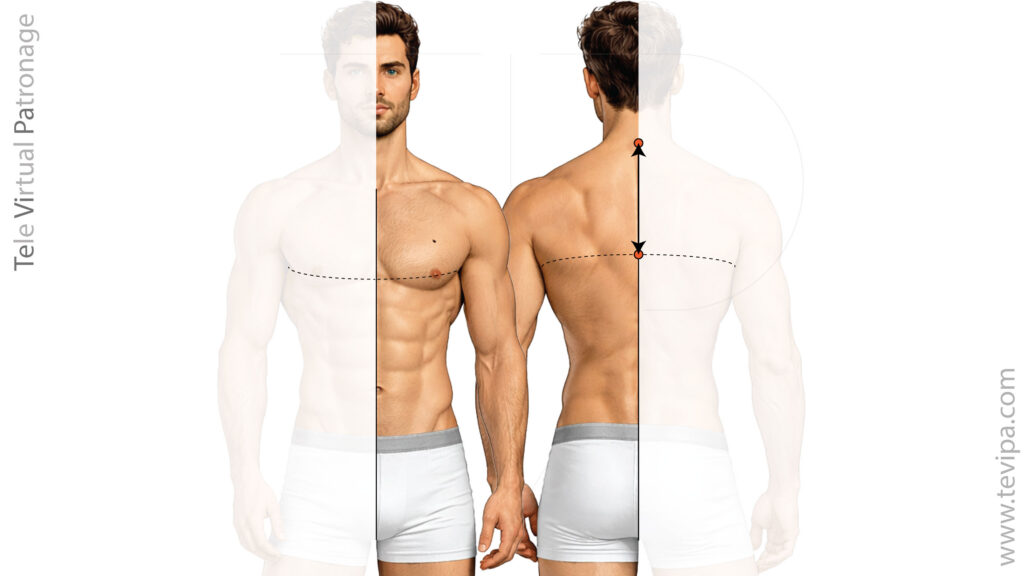
Click on this link to see how to take the armhole length measurement.
You can derive this measurement. We calculate it based on the half chest circumference.
“LS” defines the armhole length and “p” defines the chest measurement (half chest circumference).
Back length
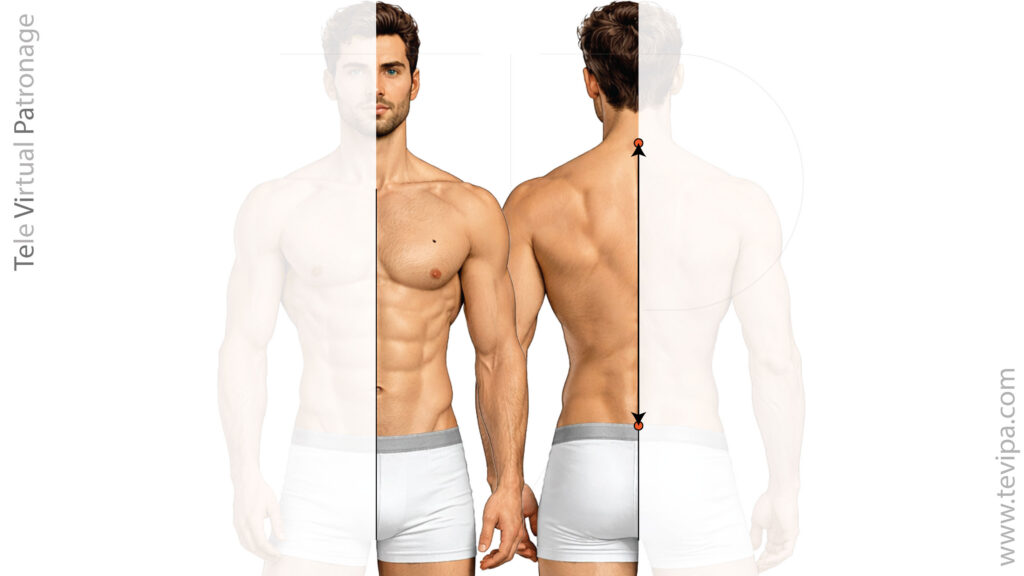
Click on this link to see how to take the back length measurement.
You cannot derive this measurement, so you must take it from the client or use a size table.
Total length
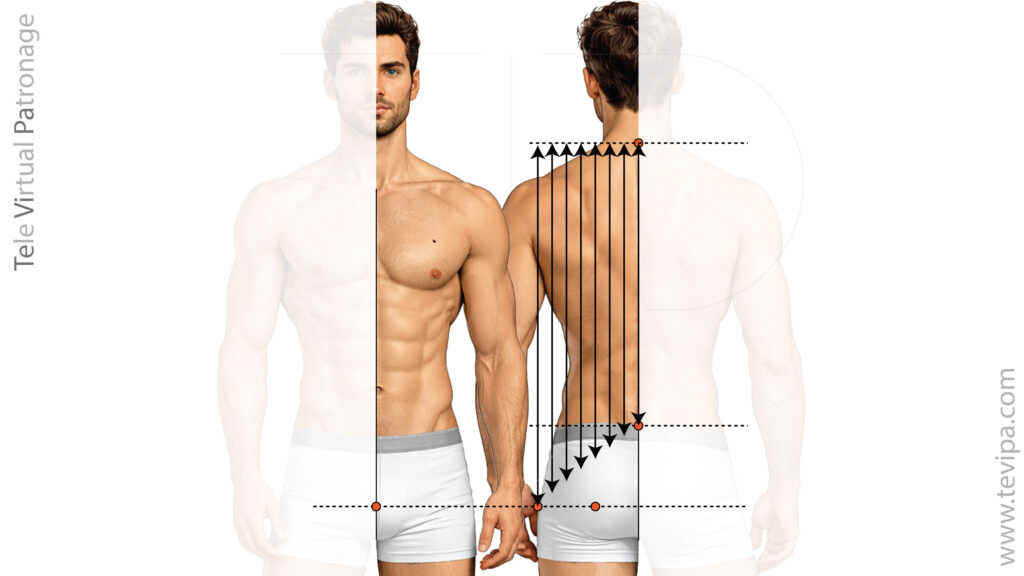
The total length of the casual jacket can range from the waist (equal to the back length) to the hip.
If you do not have the client’s hip length, you can calculate it.
The rise crotch approximately equals the armhole length, since both correspond roughly to the height of one head in classical body proportions.
If the hip sits at two thirds of the rise crotch:
“LBE” defines the back length and “LS” defines the armhole length.
Back width
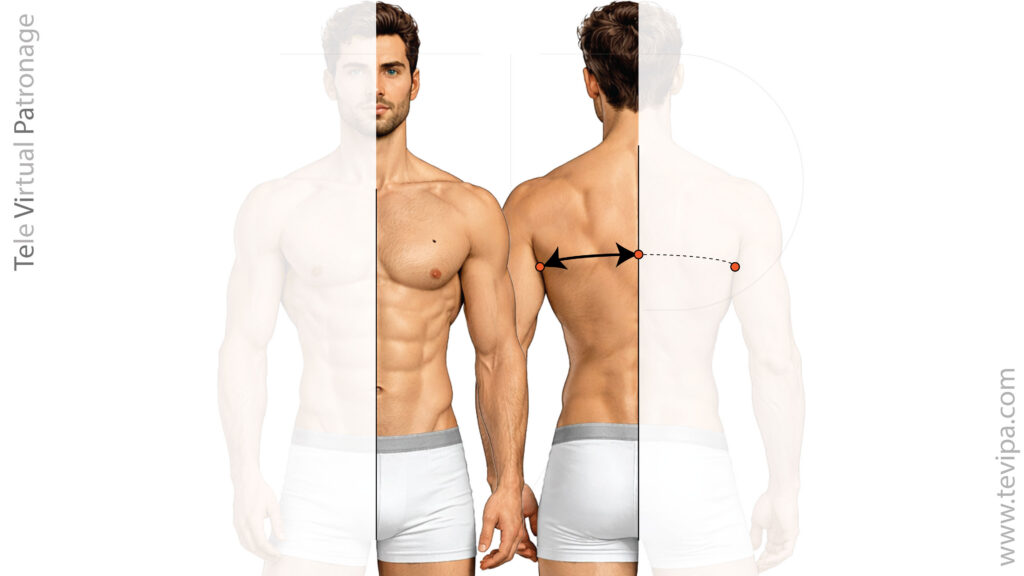
Click on this link to see how to take this measurement.
You should derive this measurement:
“AE” defines the back width; “hAE” defines the back width ease; “cost” defines the seam allowance value; and “p” defines the chest measurement.
In this case, seam allowances equal one centimeter, so the value corresponds to the multiplier.
Armhole rectangle width
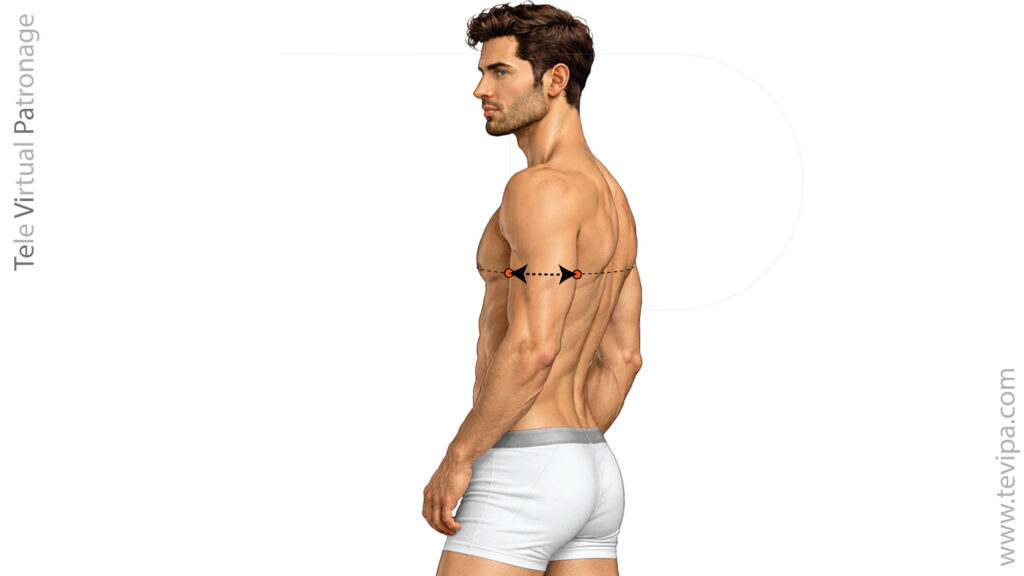
Click on this link to see how to take the Armhole rectangle width.
The ARS (armhole rectangle width) defines the portion of the body circumference occupied by the arm.
The ease may include seams or not.
You should derive this measurement instead of measuring it
“ARS” defines the armhole rectangle width; “hARS” defines the ease; and “p” defines the chest measurement.
Front width
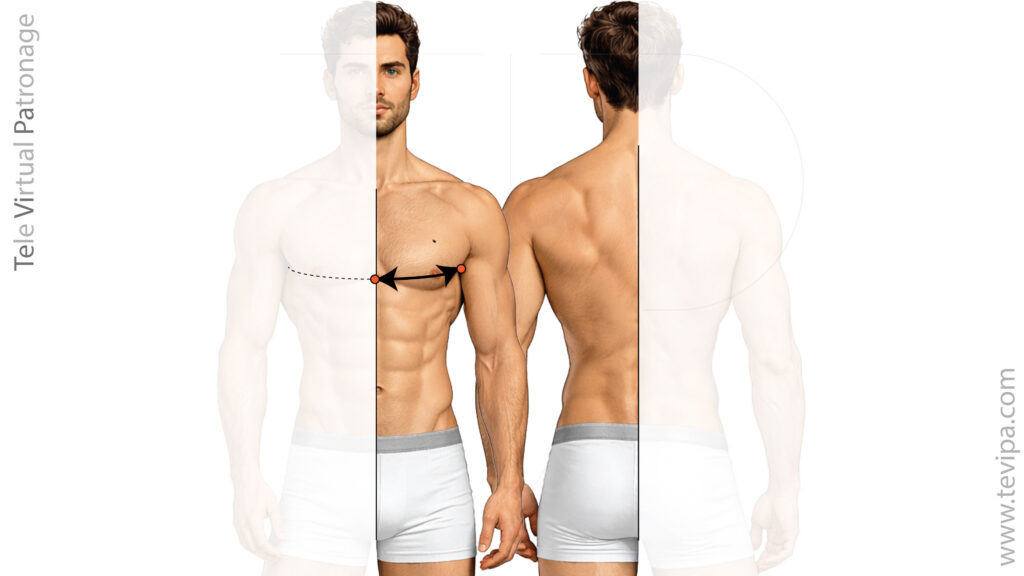
Click on this link to see how to take the front width measurement.
For garments outside classic tailoring, such as the casual jacket, you should derive this measurement
“AD” defines the front width; “hAD” defines the ease; “cost” defines the seam allowance value; and “p” defines the chest measurement.
In this case, seam allowances equal one centimeter.
Arm
You can take arm measurements from the spine or from the acromion.
If you take them from the spine, subtract the back width and apply the result from the sleeve heeel.
If you take them from the acromion, apply them from the acromion line and add 1 cm due to the sleeve cap seam. In the video at the end of this blog, we use arm measurements taken from the acromion.
Elbow length (from back or acromion)
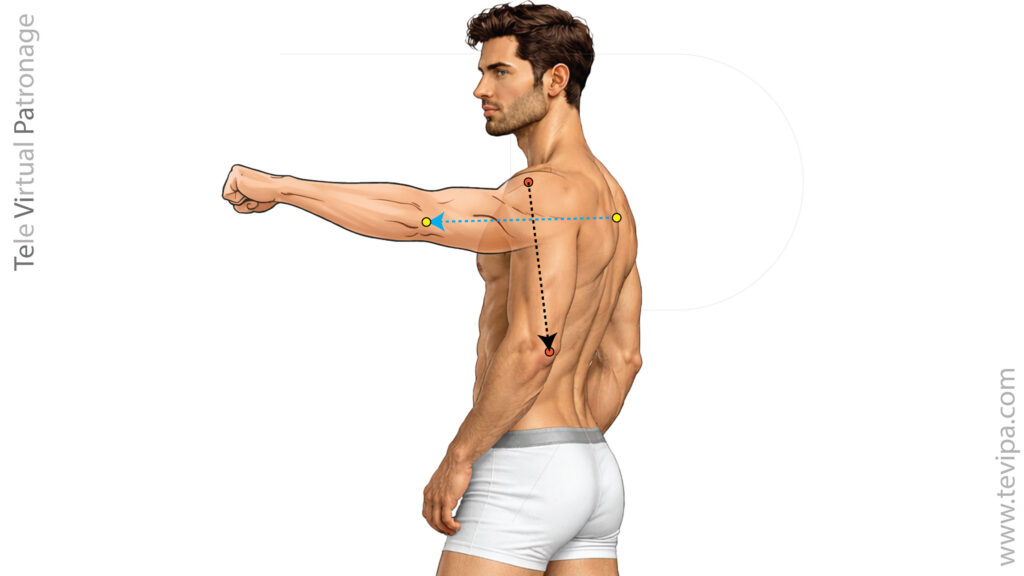
Click on this link to see how to take the elbow length from the acromion
Click on this link to see how to take the elbow length from the spine
You cannot derive this measurement.
Cuff length (from back or acromion)
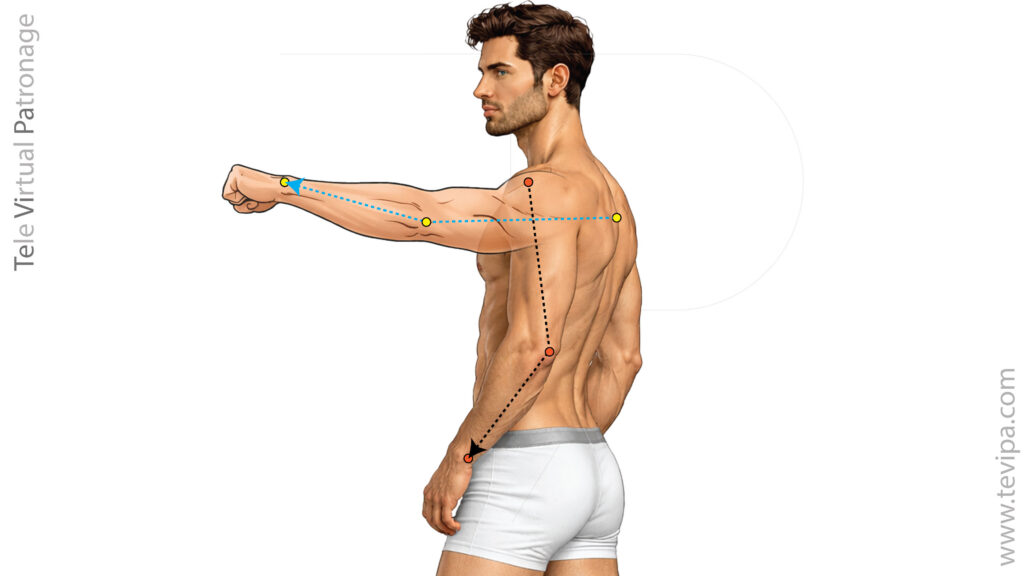
Click on this link to see how to take the cuff length from the acromion
Click on this link to see how to take the cuff length from the spine
You cannot derive this measurement.
Cuff width.
Click on the link to see how to take the cuff width measurement.
You can obtain the cuff width from the half circumference of the closed cuff or by adding ease to the wrist half circumference.
Technical construction measurements
You derive these from the previous measurements and from parts of the body drafting.
You use them to draft the sleeve pattern.
Armhole depth
The armhole depth defines the vertical diameter of the armhole once sewn. You calculate it on the body pattern.
Sleeve rectangle width.
The sleeve rectangle width defines the maximum width of the sleeve construction lines.
It equals the armhole rectangle width plus one tenth of either the armhole circumference or the chest circumference, plus two centimeters of seam allowance..
The direct calculation uses seven twentieths of the chest measurement, plus the armhole rectangle ease and two centimeters of seam allowance.
“ARM” defines the sleeve rectangle width; “ARS” defines the armhole rectangle width; “cost” defines the seam allowance; “hARS” defines the ease; and “p” defines the chest measurement.
Casual jacket pattern nomenclature
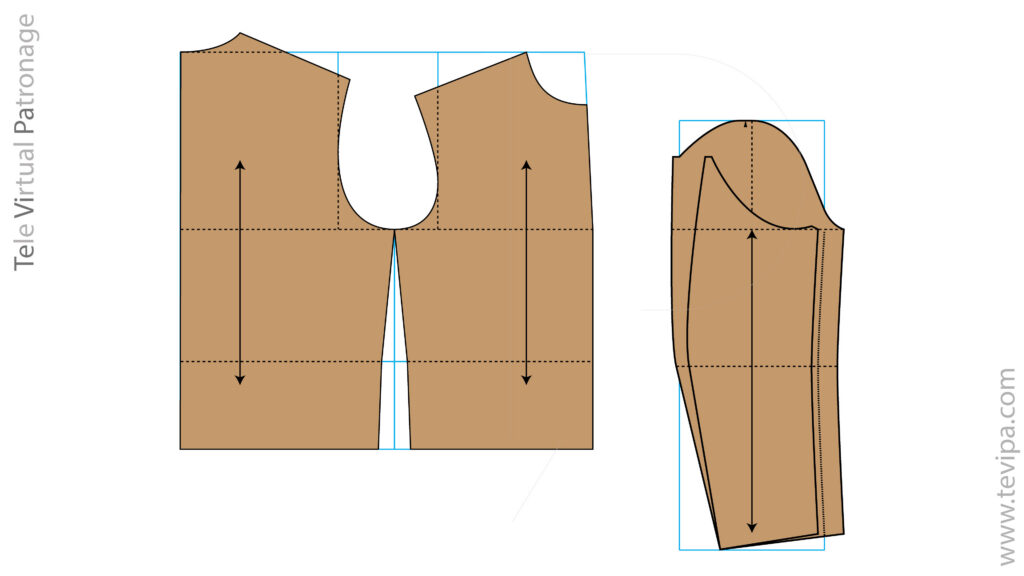
Construction lines
We divide this section into three groups: horizontal construction lines, vertical construction lines, and the oblique line.
Horizontal construction lines
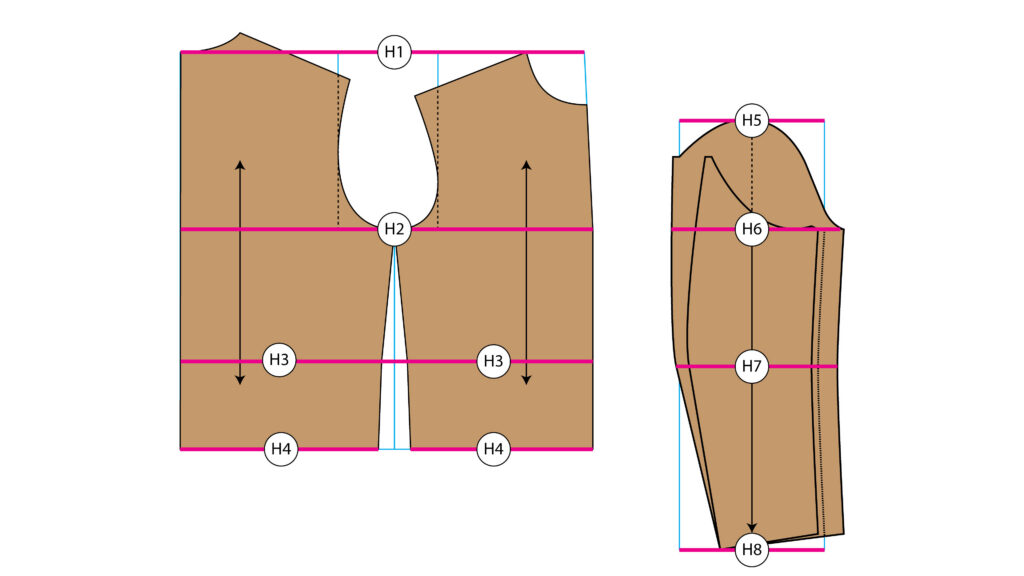
- H1 – Construction line of the seventh cervical vertebra
- H2 – Armhole construction line
- H3 – Waist construction line
- H4 – Hem or bottom construction line
- H5 – Apex or acromion construction line
- H6 – Elbow construction line
- H7 – Hem or bottom construction line
Vertical construction lines
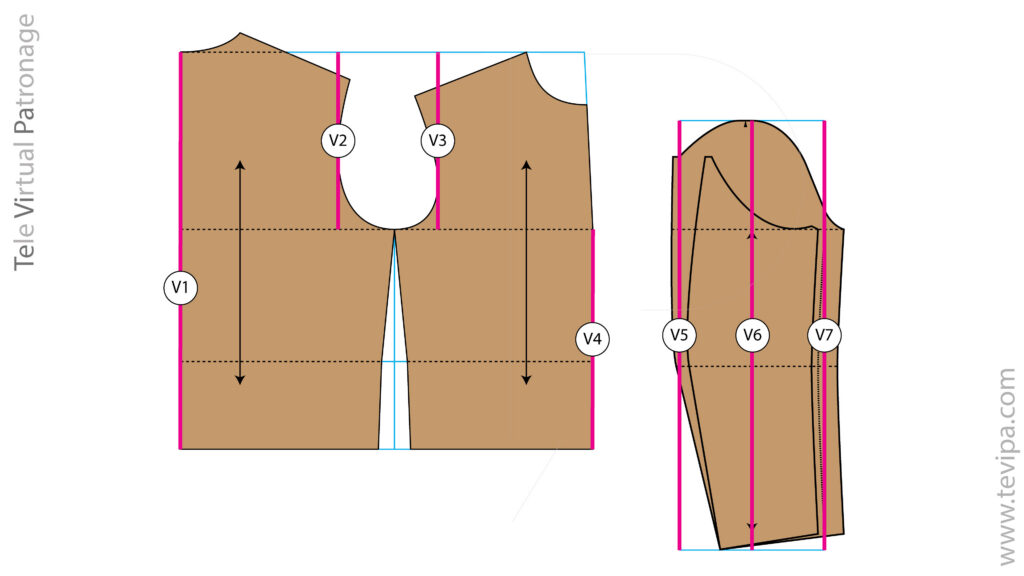
- V1 – Center back construction line
- V2 – Side panel construction line
- V3 – Side panel advance line
- V4 – Center front construction line
- V5 – Elbow construction line
- V6 – Sleeve center construction line
- V7 – Elbow advance line
Oblique construction line
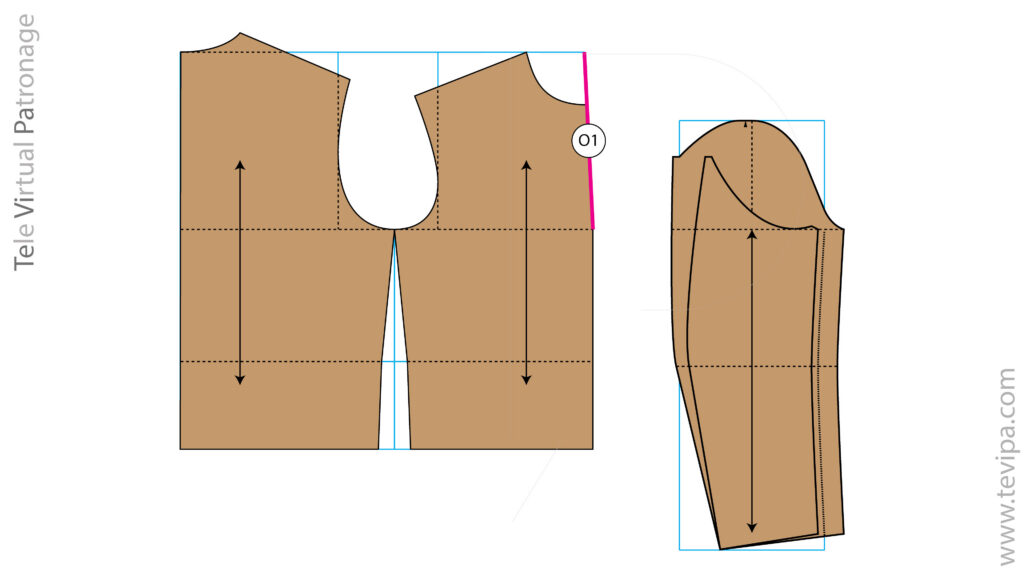
- O1 – Louis construction line
Seams, lines, and grainlines of the pattern pieces
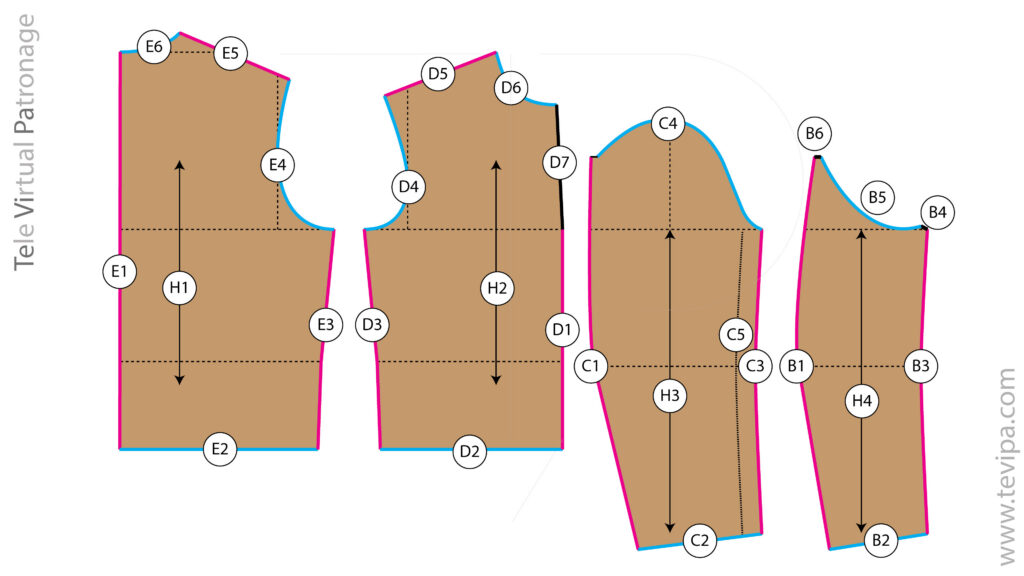
We will divide this section into the back piece, which contains all the points beginning with E; the front piece, which contains all the points beginning with D; the upper sleeve piece, which contains all the points beginning with C; and finally the under sleeve piece, which contains all the points beginning with B.
The grainlines are marked with points preceded by H. We will find one grainline in each piece
Back piece (E)
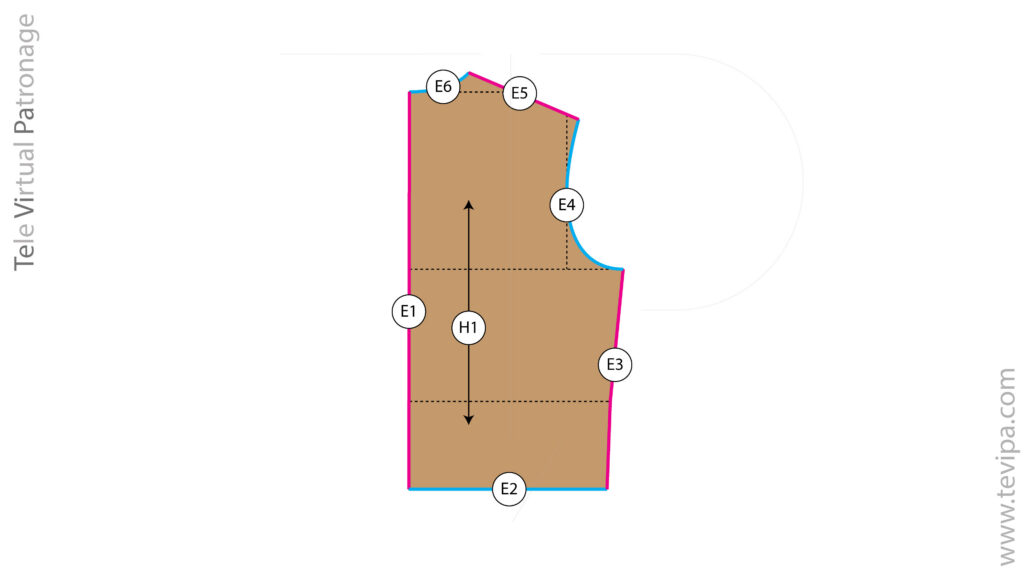
- E1 – Center back line (without seam allowance)
E2 – Hem or bottom line (without seam allowance)
E3 – Side seam (1 cm seam allowance)
E4 – Armhole seam (1 cm seam allowance)
E5 – Shoulder seam (1 cm seam allowance)
E6 – Back neckline seam (1 cm seam allowance)
H1 – Grainline of the back piece
Front piece (D)
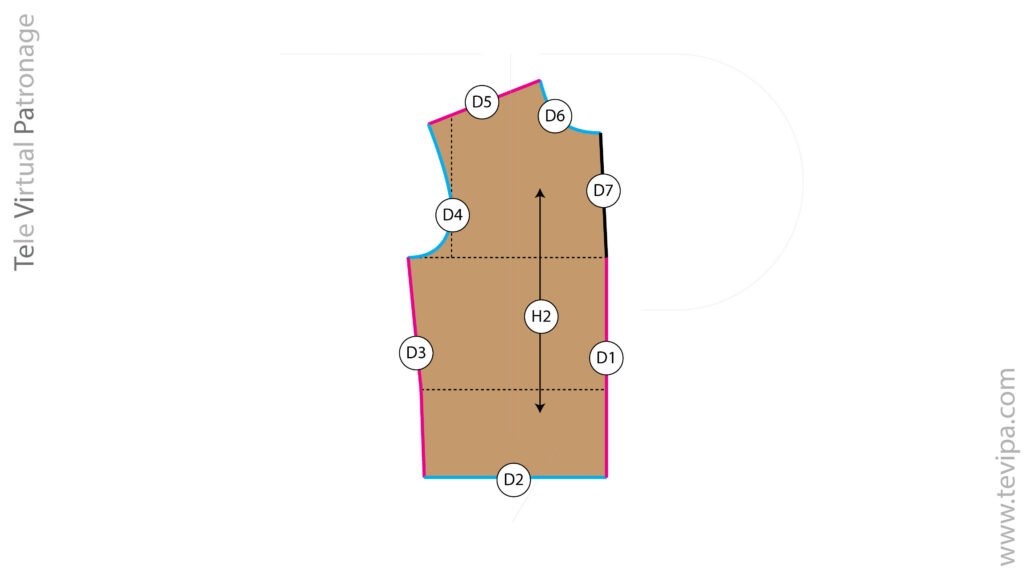
- D1 – Center front line (without seam allowance)
D2 – Hem line (without seam allowance)
D3 – Side seam (1 cm seam allowance)
D4 – Armhole seam (1 cm seam allowance)
D5 – Shoulder seam (1 cm seam allowance)
D6 – Front neckline seam (1 cm seam allowance)
D7 – Louis seam (1 cm seam allowance)
H2 – Grainline of the front piece
Upper sleeve piece (C)
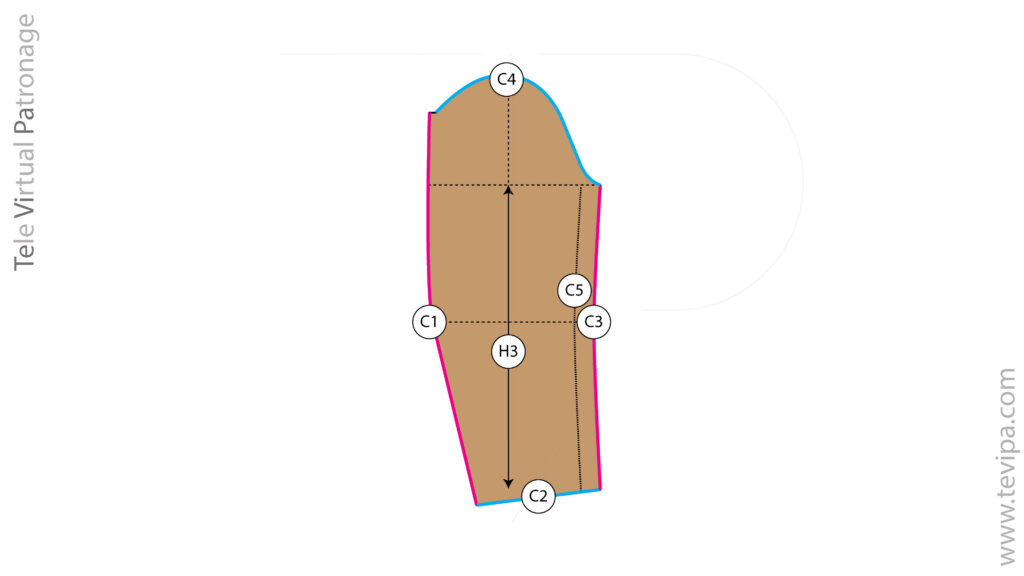
- C1 – Elbow seam (1 cm seam allowance)
C2 – Hem or bottom line (without seam allowance)
C3 – Bleeding seam or blooding seam (1 cm seam allowance)
C4 – Sleeve cap seam or sleeve head seam (1 cm seam allowance)
C5 – Bleeding line or blood line (1 cm seam allowance)
H3 – Grainline of the upper sleeve piece
Under sleeve piece (B)
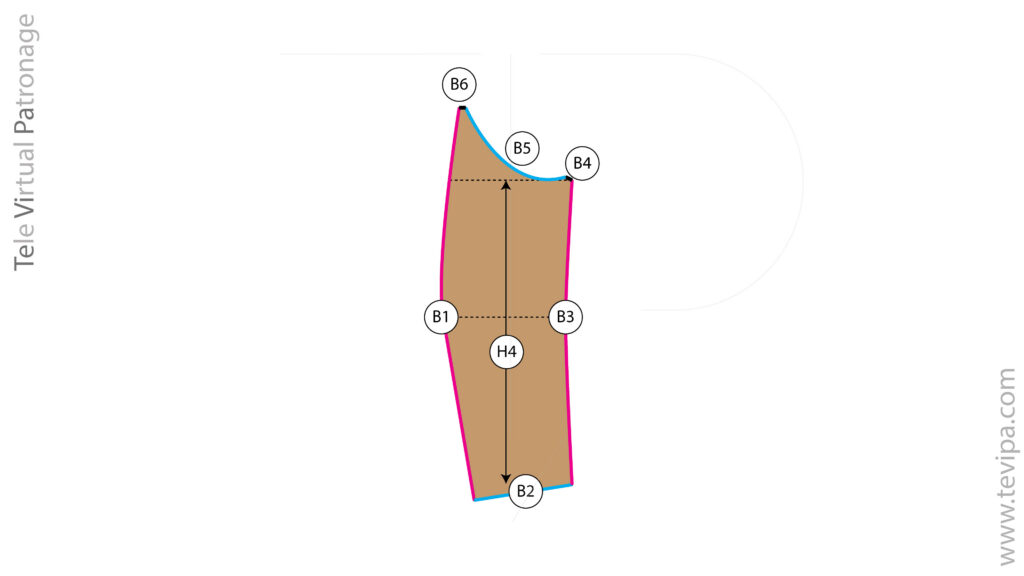
- B1 – Elbow seam (1 cm seam allowance)
B2 – Hem or bottom line (without seam allowance)
B3 – Bleeding seam or bleeding line seam (1 cm seam allowance)
B4 – Bleeding seam heel (1 cm seam allowance)
B5 – Under sleeve seam (1 cm seam allowance)
B6 – Shoulder seam (1 cm seam allowance)
H4 – Grainline of the under sleeve piece
Other structural parts
In this section, we study other lines that may be considered measurements rather than lines.
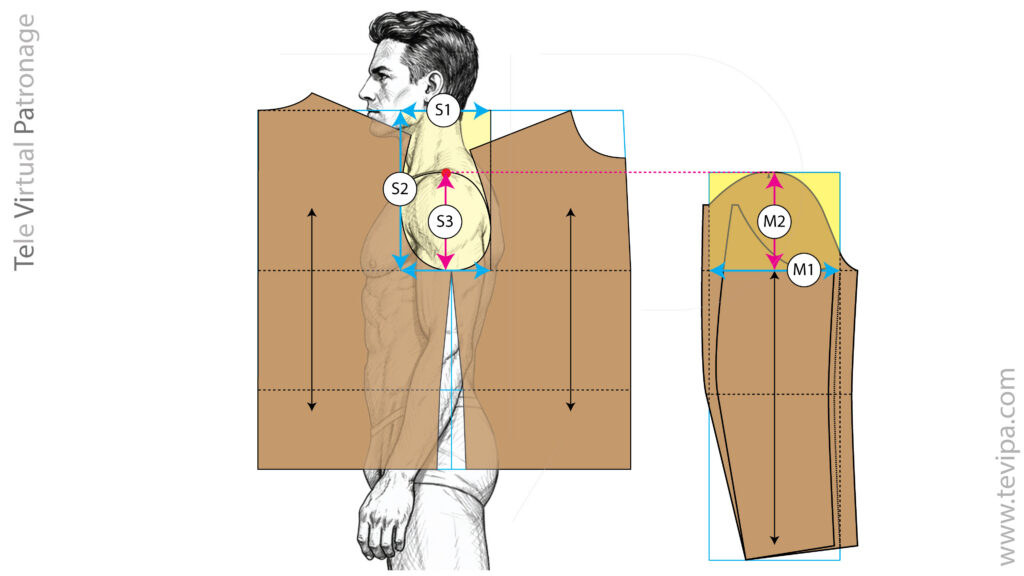
The armhole rectangle
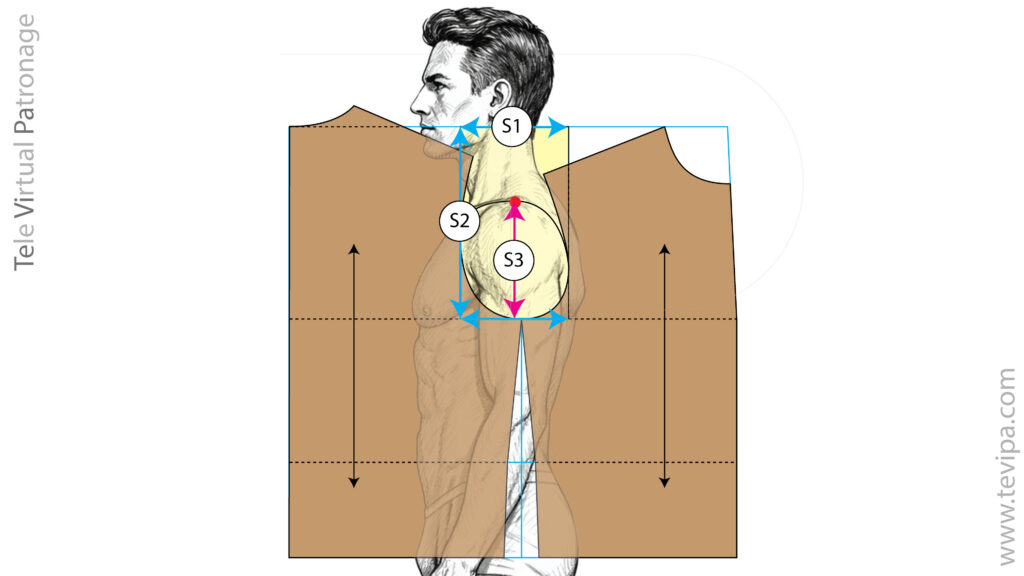
- S1 – Armhole rectangle width
S2 – Armhole rectangle length
S3 – Armhole depth
The sleeve rectangle:
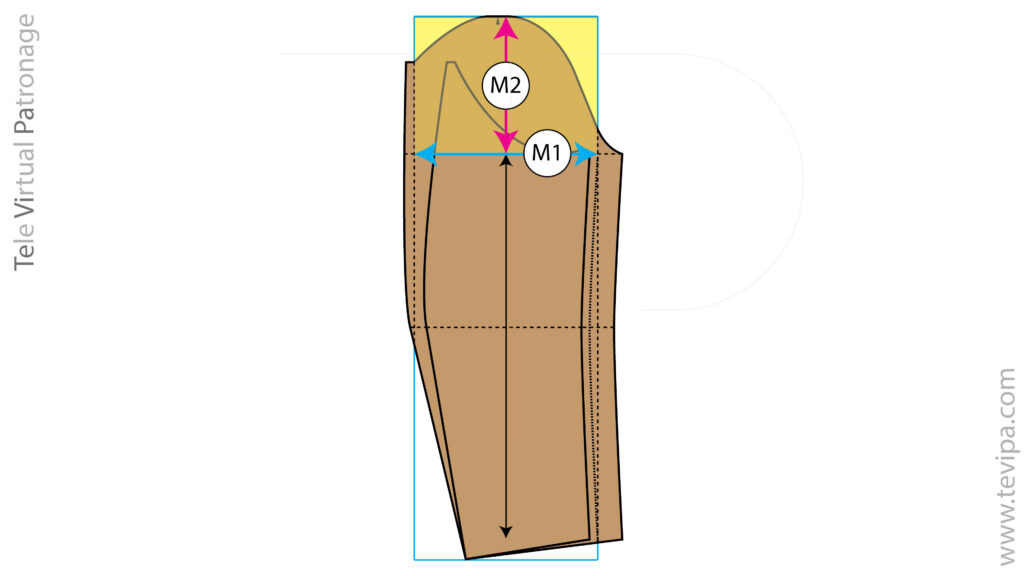
- M1 – Sleeve rectangle width
- M2 – Armhole depth
Drafting the pattern step by step
To see the complete step-by-step drafting process, you can access the video here. It develops the entire system continuously, from the first line to the final construction of the pattern.