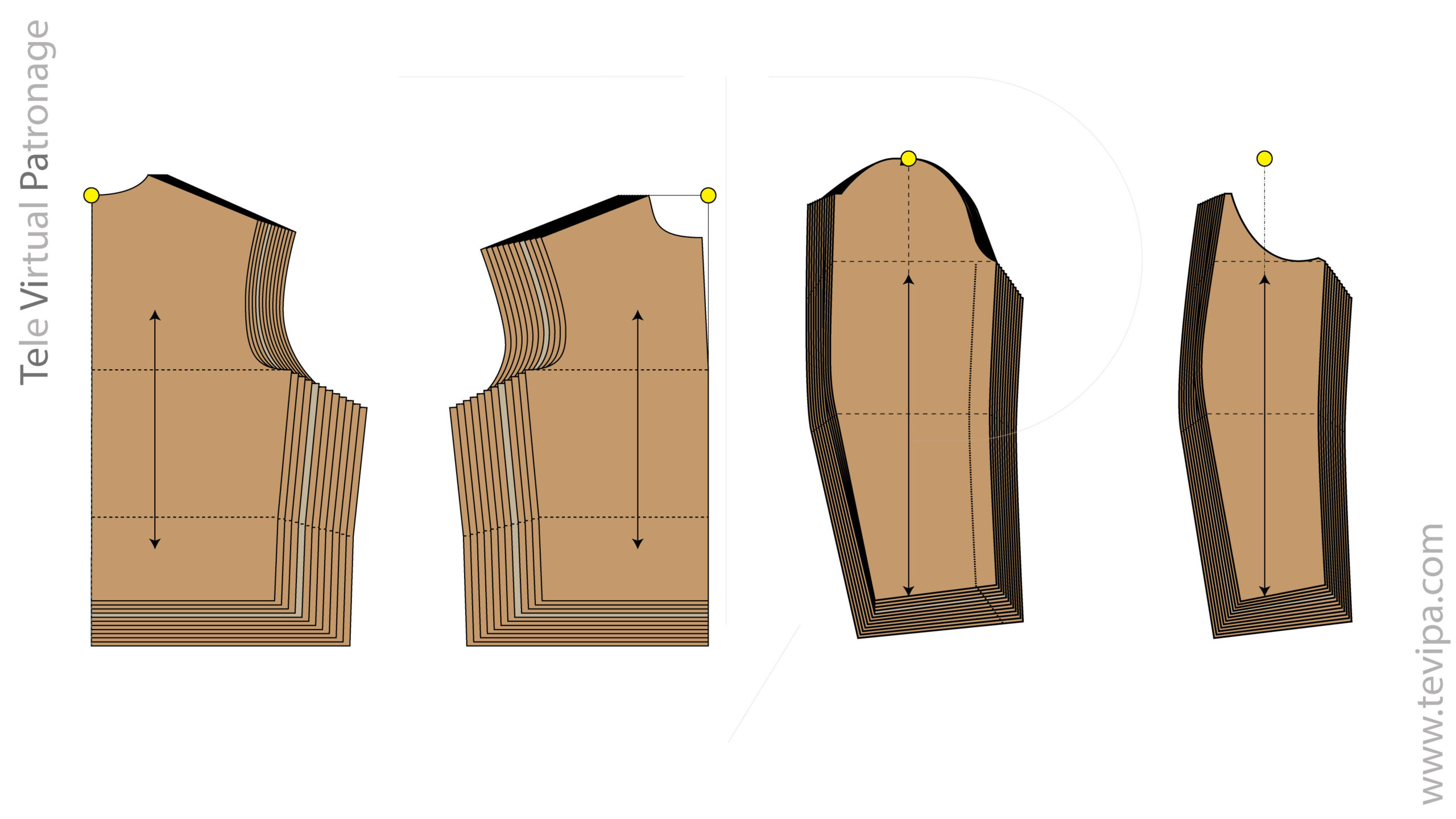
Ease and grading of the casual jacket
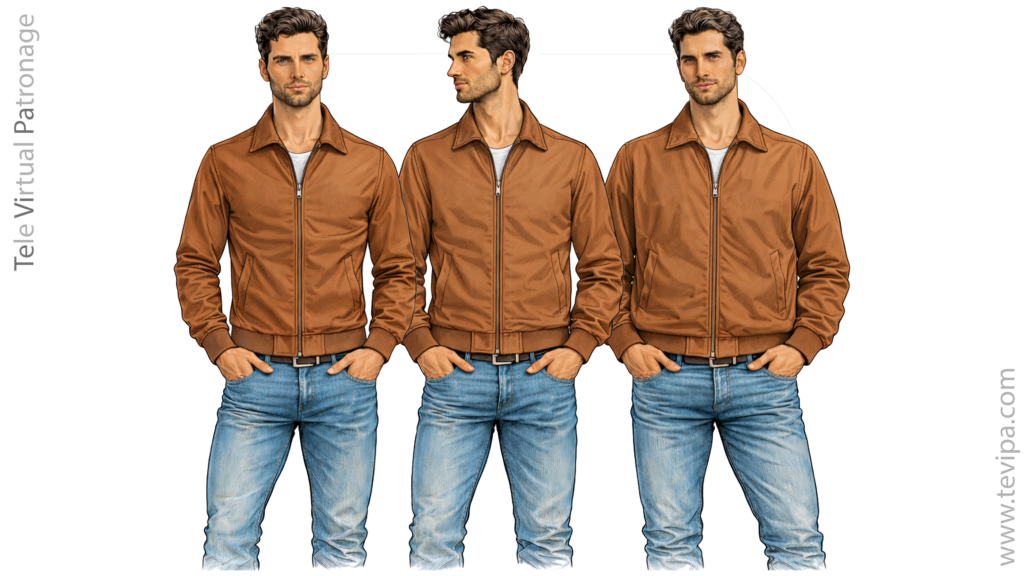
Ease in the casual jacket
The video shows how to build the base pattern of the casual jacket with different ease values.
Different ease values produce a narrow, regular, wide or very wide jacket.
Ease in the base pattern affects four measurements: one vertical, the armhole depth; and three related to chest circumference: back width (AE), armhole rectangle width (ARS), and front width (AD).
In this case, back width and front width include a 1 cm seam allowance along the armhole seams of the front and back pieces. The center front and center back lines do not include seam allowances. The armhole rectangle width does not include seam allowance, since the front and back widths already absorb it.
The proportional distribution of the chest, explained in the post “Casual Jacket Block – Drafting“, also introduces additional ease. The sum of both body sections and the armhole width exceeds the actual chest measurement.
We call this additional ease technical ease (ht).
Technical ease allows movement and absorbs differences between bodies. It lets people with the same chest circumference wear the same size without compromising functionality.
Its value is:
Technical ease comes from subtracting a proportion of the chest, so it is not constant. It decreases as chest circumference increases.
Tabla de las holguras de la cazadora
| CZ | Tot_h_p | hLS | hAE | hARS | hAD |
| 1 | 5 | 2 | 1 | 3 | 1 |
| 2 | 7 | 3 | 2 | 3 | 2 |
| 3 | 9 | 4 | 3 | 3 | 3 |
| 4 | 12 | 5 | 4 | 4 | 4 |
- Legend:
- CZ: jacket type
- Tot_h_p: total chest ease
- hLS: vertical armhole ease
- hAE: back width ease
- hARS: armhole rectangle width ease
- hAD: front width ease
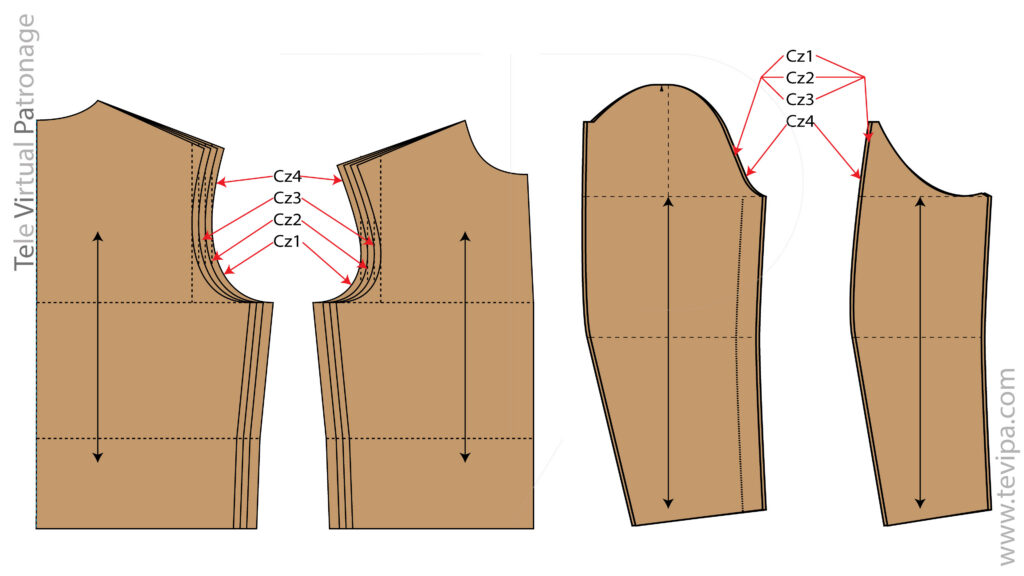
We distinguish four jacket types:
Type “1” gives the narrowest fit; “2” gives a regular fit; “3” produces a wide jacket; and “4” produces a very wide jacket.
The table shows how each ease value affects the pattern. The next table develops the full proportional calculations.
The post “Casual jackets – classification and patternmaking logic” analyzes these models. From that analysis, we derive the relationship between ease values and each jacket type.
Ease by jacket type
| Modelo de cazadora | 1 | 2 | 3 | 4 |
| Bomber | x | x | ||
| Aviador (shearling) | x | x | ||
| Parka corta | x | x | ||
| Windbreaker | x | |||
| Track jacket | x | x | ||
| Softshell | x | |||
| Biker o perfecto | x | |||
| Café racer | x | |||
| Harrington | x | |||
| Trucker | x | x | ||
| Varsity | x | x |
The following table shows all calculations required to draft base patterns with four ease levels, for sizes 42 to 64.
Base pattern calculations for the casual jacket
| 42 | 44 | 46 | 48 | 50 | 52 | 54 | 56 | 58 | 60 | 62 | 64 | ||
| LS | 21.50 | 22.00 | 22.50 | 23.00 | 23.50 | 24.00 | 24.50 | 25.00 | 25.50 | 26.00 | 26.50 | 27.00 | |
| AE | 18.50 | 19.00 | 19.50 | 20.00 | 20.50 | 21.00 | 21.50 | 22.00 | 22.50 | 23.00 | 23.50 | 24.00 | |
| ARS | 10.50 | 11.00 | 11.50 | 12.00 | 12.50 | 13.00 | 13.50 | 14.00 | 14.50 | 15.00 | 15.50 | 16.00 | |
| AD | 16.80 | 17.60 | 18.40 | 19.20 | 20.00 | 20.80 | 21.60 | 22.40 | 23.20 | 24.00 | 24.80 | 25.60 | |
| 1 | LS+2 | 23.50 | 24.00 | 24.50 | 25.00 | 25.50 | 26.00 | 26.50 | 27.00 | 27.50 | 28.00 | 28.50 | 29.00 |
| AE+1+1 | 20.50 | 21.00 | 21.50 | 22.00 | 22.50 | 23.00 | 23.50 | 24.00 | 24.50 | 25.00 | 25.50 | 26.00 | |
| ARS+3 | 13.50 | 14.00 | 14.50 | 15.00 | 15.50 | 16.00 | 16.50 | 17.00 | 17.50 | 18.00 | 18.50 | 19.00 | |
| AD+1+1 | 18.80 | 19.60 | 20.40 | 21.20 | 22.00 | 22.80 | 23.60 | 24.40 | 25.20 | 26.00 | 26.80 | 27.60 | |
| ARM | 19.70 | 20.40 | 21.10 | 21.80 | 22.50 | 23.20 | 23.90 | 24.60 | 25.30 | 26.00 | 26.70 | 27.40 | |
| dtoPS | 4.50 | 4.67 | 4.83 | 5.00 | 5.17 | 5.33 | 5.50 | 5.67 | 5.83 | 6.00 | 6.17 | 6.33 | |
| Tot_P | 52.80 | 54.60 | 56.40 | 58.20 | 60.00 | 61.80 | 63.60 | 65.40 | 67.20 | 69.00 | 70.80 | 72.60 | |
| Tot_h | 10.80 | 10.60 | 10.40 | 10.20 | 10.00 | 9.80 | 9.60 | 9.40 | 9.20 | 9.00 | 8.80 | 8.60 | |
| 2 | LS+3 | 24.50 | 25.00 | 25.50 | 26.00 | 26.50 | 27.00 | 27.50 | 28.00 | 28.50 | 29.00 | 29.50 | 30.00 |
| AE+2+1 | 21.50 | 22.00 | 22.50 | 23.00 | 23.50 | 24.00 | 24.50 | 25.00 | 25.50 | 26.00 | 26.50 | 27.00 | |
| ARS+3 | 13.50 | 14.00 | 14.50 | 15.00 | 15.50 | 16.00 | 16.50 | 17.00 | 17.50 | 18.00 | 18.50 | 19.00 | |
| AD+2+1 | 19.80 | 20.60 | 21.40 | 22.20 | 23.00 | 23.80 | 24.60 | 25.40 | 26.20 | 27.00 | 27.80 | 28.60 | |
| ARM | 19.70 | 20.40 | 21.10 | 21.80 | 22.50 | 23.20 | 23.90 | 24.60 | 25.30 | 26.00 | 26.70 | 27.40 | |
| dtoPS | 4.50 | 4.67 | 4.83 | 5.00 | 5.17 | 5.33 | 5.50 | 5.67 | 5.83 | 6.00 | 6.17 | 6.33 | |
| Tot_P | 54.80 | 56.60 | 58.40 | 60.20 | 62.00 | 63.80 | 65.60 | 67.40 | 69.20 | 71.00 | 72.80 | 74.60 | |
| Tot_h+c | 12.80 | 12.60 | 12.40 | 12.20 | 12.00 | 11.80 | 11.60 | 11.40 | 11.20 | 11.00 | 10.80 | 10.60 | |
| 3 | LS+4 | 25.50 | 26.00 | 26.50 | 27.00 | 27.50 | 28.00 | 28.50 | 29.00 | 29.50 | 30.00 | 30.50 | 31.00 |
| AE+3+1 | 22.50 | 23.00 | 23.50 | 24.00 | 24.50 | 25.00 | 25.50 | 26.00 | 26.50 | 27.00 | 27.50 | 28.00 | |
| ARS+3 | 13.50 | 14.00 | 14.50 | 15.00 | 15.50 | 16.00 | 16.50 | 17.00 | 17.50 | 18.00 | 18.50 | 19.00 | |
| AD+3+1 | 20.80 | 21.60 | 22.40 | 23.20 | 24.00 | 24.80 | 25.60 | 26.40 | 27.20 | 28.00 | 28.80 | 29.60 | |
| ARM | 19.70 | 20.40 | 21.10 | 21.80 | 22.50 | 23.20 | 23.90 | 24.60 | 25.30 | 26.00 | 26.70 | 27.40 | |
| dtoPS | 4.50 | 4.67 | 4.83 | 5.00 | 5.17 | 5.33 | 5.50 | 5.67 | 5.83 | 6.00 | 6.17 | 6.33 | |
| Tot_P | 56.80 | 58.60 | 60.40 | 62.20 | 64.00 | 65.80 | 67.60 | 69.40 | 71.20 | 73.00 | 74.80 | 76.60 | |
| Tot_h | 14.80 | 14.60 | 14.40 | 14.20 | 14.00 | 13.80 | 13.60 | 13.40 | 13.20 | 13.00 | 12.80 | 12.60 | |
| 4 | LS+5 | 26.50 | 27.00 | 27.50 | 28.00 | 28.50 | 29.00 | 29.50 | 30.00 | 30.50 | 31.00 | 31.50 | 32.00 |
| AE+4+1 | 23.50 | 24.00 | 24.50 | 25.00 | 25.50 | 26.00 | 26.50 | 27.00 | 27.50 | 28.00 | 28.50 | 29.00 | |
| ARS+4 | 14.50 | 15.00 | 15.50 | 16.00 | 16.50 | 17.00 | 17.50 | 18.00 | 18.50 | 19.00 | 19.50 | 20.00 | |
| AD+4+1 | 23.50 | 24.00 | 24.50 | 25.00 | 25.50 | 26.00 | 26.50 | 27.00 | 27.50 | 28.00 | 28.50 | 29.00 | |
| ARM | 20.70 | 21.40 | 22.10 | 22.80 | 23.50 | 24.20 | 24.90 | 25.60 | 26.30 | 27.00 | 27.70 | 28.40 | |
| dtoPS | 4.83 | 5.00 | 5.17 | 5.33 | 5.50 | 5.67 | 5.83 | 6.00 | 6.17 | 6.33 | 6.50 | 6.67 | |
| Tot_P | 61.50 | 63.00 | 64.50 | 66.00 | 67.50 | 69.00 | 70.50 | 72.00 | 73.50 | 75.00 | 76.50 | 78.00 | |
| Tot_h | 19.50 | 19.00 | 18.50 | 18.00 | 17.50 | 17.00 | 16.50 | 16.00 | 15.50 | 15.00 | 14.50 | 14.00 | |
- Leyenda
- La primera fila corresponde a la medida de talla (medio contorno de pecho)
- Ls: Largo de sosa
- AE: Ancho de espalda
- ARS: Ancho de rectángulo de sisa
- AD: ancho del delantero
- 1: Cazadora muy estrecha
- 2: Cazadora regular
- 3: Cazadora ancha
- 4: Cazadora muy ancha
- ARM: Ancho de rectángulo de manga
- dto_PS: Descuento para el cálculo de la profundidad de sisa
- Tot_P: Total de medida de pecho del patrón
- Tot_h: Total de holgura de la prenda respecto a la medida de pecho.
Grading of the casual jacket base pattern
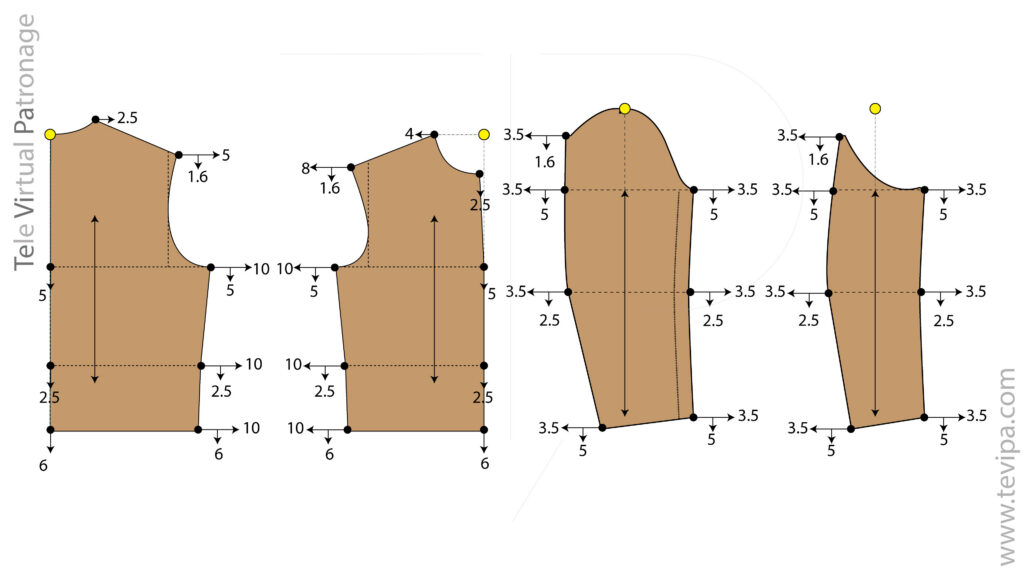
We already explained garment grading in the corresponding post “Pattern Grading: Complete 3-Part Guide“. Here we apply those ratios to the casual jacket pattern.
Grading depends exclusively on proportions derived from chest circumference. Constant terms in the formulas, as well as variations due to height or ease, do not affect grading ratios. They act as independent additions and do not alter size progression.
We use the previous table to calculate the grading ratios of the casual jacket base pattern.
Some measurements still depend on height: body height, back length, elbow length, and sleeve length. Including height requires adjusting the armhole depth.
For size 50 (100 cm chest circumference) and average height (174 cm), armhole depth equals 23.5 cm:
For taller individuals (180 cm), it increases by 0.5 cm (24 cm). For shorter ones (168 cm), it decreases by 0.5 cm (23 cm).
The grading ratio for armhole depth is ±5 mm depending on height.
Back length equals 45.25 cm for size 50 at average height (174 cm).
It increases by 2 cm for taller individuals and decreases by 2 cm for shorter ones.
The grading ratio per size is ±2.5 mm.
Sleeve length from the acromion equals 62.5 cm for size 50 at average height.
It increases or decreases by 2 cm depending on height.
The grading ratio is ±5 mm.
All other ratios come directly from the proportional table.
Points along the armhole line on the front and back pieces move vertically by +5 mm for larger sizes. Although not exact, we apply the same increase to the sleeve armhole line.
The waist line (from the seventh cervical vertebra to the fourth lumbar vertebra) increases by 0.25 cm per size (2.5 mm).
The hem grows by adding the waist ratio and two-thirds of the armhole ratio:
The front shoulder point moves by one quarter of 20 mm, that is 5 mm.
The back shoulder point moves by two fifths of 20 mm, that is 8 mm.
For the side seam, we add 10 mm in total, distributed equally on both sides.
The back neckline point moves by one eighth of 2 cm (2.5 mm) and rises by one third of the horizontal ratio (≈0.83 mm, negligible).
The shoulder slope (front and back) drops by twice the rise of the back neckline point (≈1.6 mm).
The front neckline opens by one fifth of the chest (4 mm) and drops along the Louis line by one eighth of the chest (2.5 mm).
The sleeve
The sleeve rectangle grows by one quarter plus one tenth of the chest:
5 mm + 2 mm = 7 mm
We place anchor points at the midpoint of the sleeve rectangle width along the acromion line. As a result, both the elbow seam and the pitch seam shift by 3.5 mm.
Vertically, the sleeve heel moves by one third of the armhole ratio (5 mm), that is 1.6 mm. The total sleeve length increases by 5 mm per size. The elbow position increases by half that amount, 2.5 mm.