
Tear-away pants
Description of tear-away pants
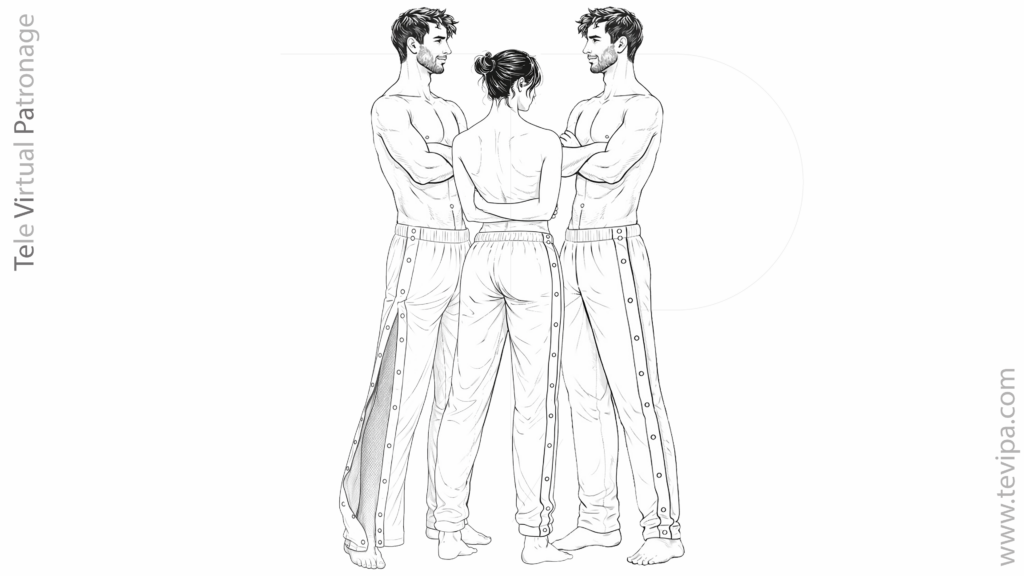
Descripción del pantalón tear-away
Tear-away pants are a transformation of one-piece tracksuit trousers.
Their main characteristic is that the opening is made exclusively along both sides of the leg.
The closure is achieved by means of a series of snap fasteners distributed vertically, allowing the trousers to be opened partially or completely in a matter of seconds. The leg is therefore not removed: it separates laterally.
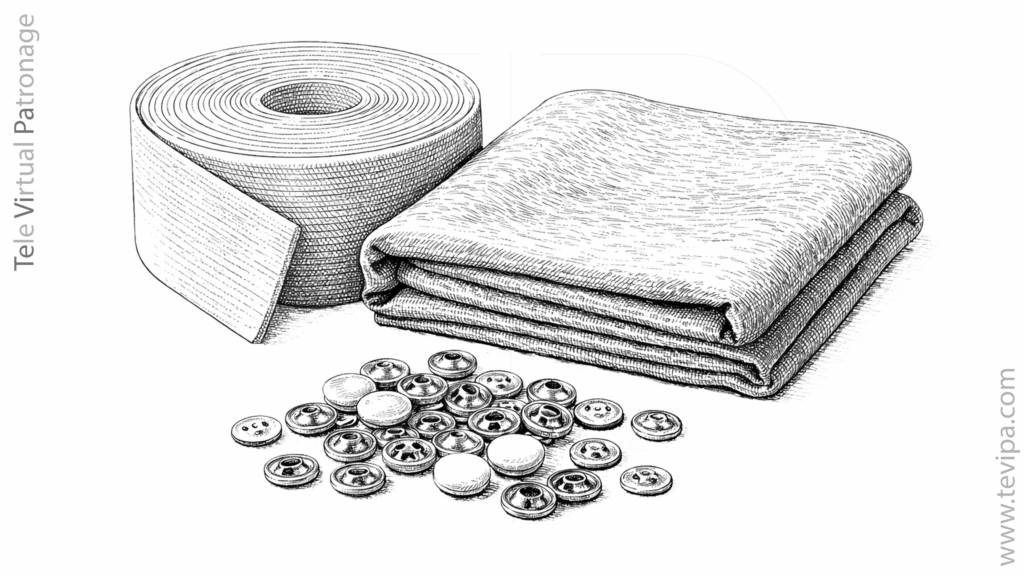
The waistband is usually elastic only, that is, without a drawstring, since the lateral opening system itself conditions the behaviour of the trousers at the waist.
This type of trousers allows the legs or anatomical areas of the lower trunk—such as the groin or the root of the thigh—to be partially uncovered without the need to fully undress, or alternatively to undress without having to remove footwear.
Use
This type of trousers can be found in three very different fields: sport, medicine and the stage.
In sport, tear-away pants are mainly used during warm-up. They allow the garment to be removed immediately, just before competition, without wasting time or having to take off shoes. Their use is especially common in basketball.
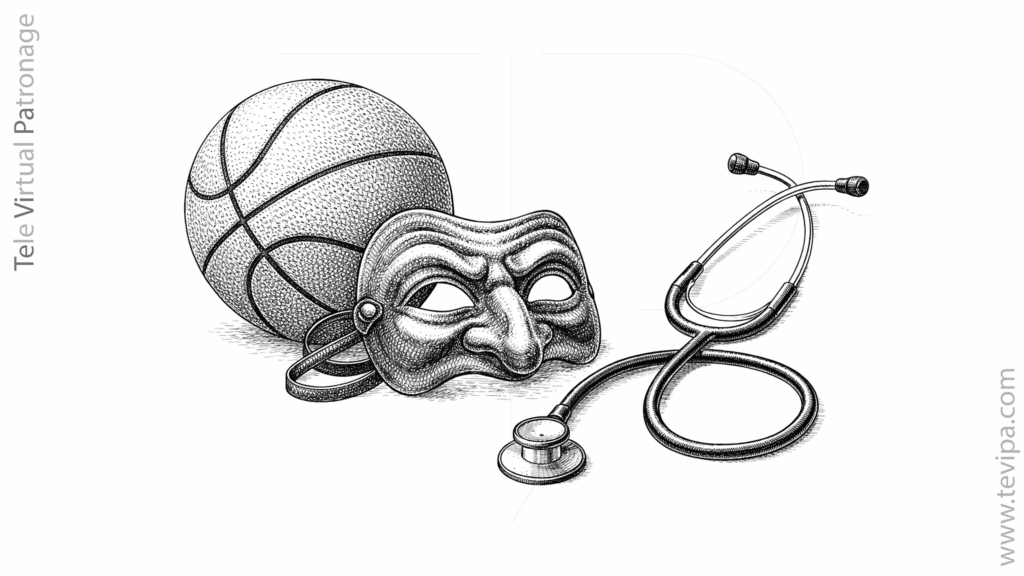
In medicine, they are particularly useful for patients with lower limb injuries or reduced mobility. They facilitate anatomical access to specific areas from the waist down—such as the groin, thigh or knee—without the need to completely undress the patient, providing comfort, speed and dignity during examinations or repeated check-ups.
In the performing arts, they are used for quick costume changes and in performances where the opening of the garment is part of the visual or narrative resource itself.
Guidelines for a functional tear-away
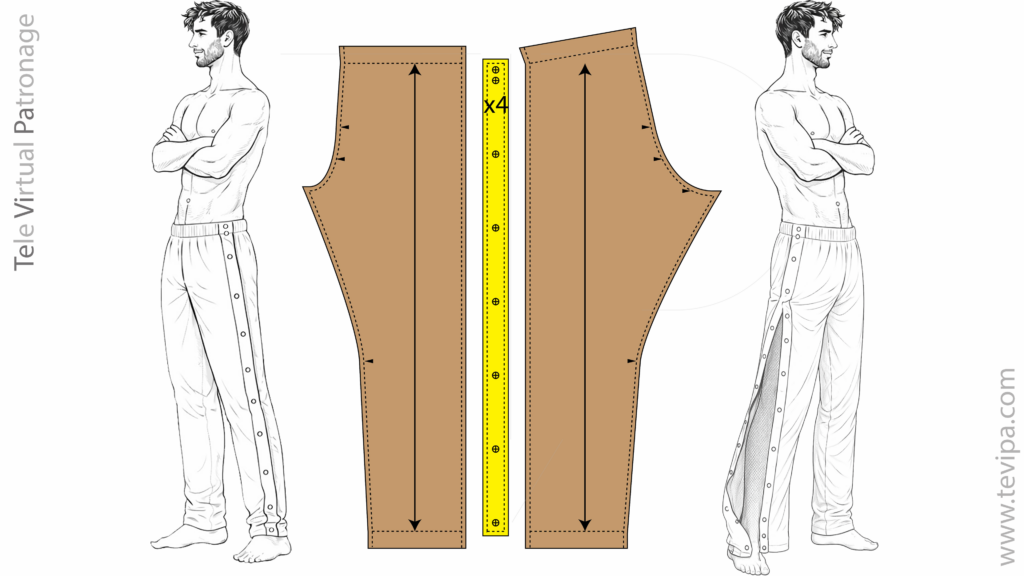
The transformation is carried out starting from one-piece tracksuit trousers. Although it would be possible to start from a two-piece pattern, the process is more immediate and coherent when working from a single-piece pattern.
The lateral construction line is identified, which coincides with the lateral axis of the leg.
By dividing the pattern along this line, two completely straight waistlines appear: the front waistband, drawn orthogonally, and the back waistband, which has a slight inclination.
When the lateral band is placed straddling the leg axis, the portion corresponding to the back waistband becomes completely straight.
If the band is very wide, a small discrepancy may appear between the band—drawn as a rectangle—and the junction of the back waistband with its construction line. This difference, which may reach a maximum of about 0.5 cm, can be disregarded without practical consequences.
The back waistband is then re-drawn from the point where the band ends.
Pockets and limitations of use
It is advisable not to add pockets.
Slanted pockets and pockets in the lateral seam are not possible, as this seam no longer exists. Patch pockets or flap pockets may be placed on both the front and the back.
It should be borne in mind that when a pocket is present, it tends to be filled, often with unnecessary objects. Despite its many advantages, this type of trousers has two weak points.
The first is that snap fasteners do not provide the same level of security as a button, even when two fasteners are placed consecutively at the waist.
The second is that elastic waistbands tend to relax with use. If additional weight is added through pockets, a gradual downward movement of the trousers may occur, which is undesirable in non-scenic uses.
Optionally, a false fly or even a functional fly may be added.
The Transformation Rag
In the following short, we show—directly and without accessory elements—the transformation of one-piece tracksuit trousers into tear-away pants, focusing exclusively on the essential structure of the pattern.