
The Beret
Parametric Geometric Construction System
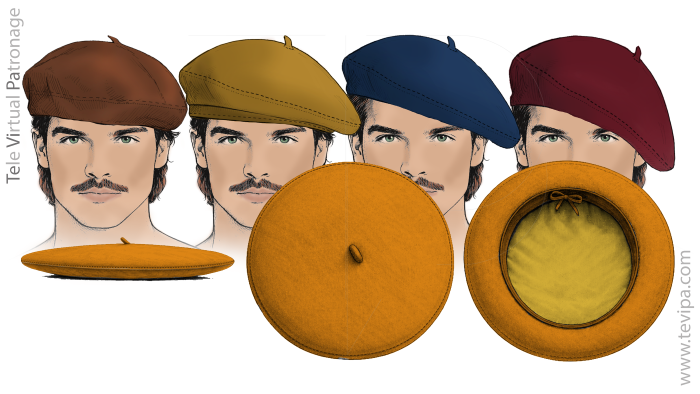
Origin and history of the beret
The beret is one of the oldest headwear garments in Europe. Although today it is commonly associated with the Basque Country and southern France, its form—a circular wool or felt cap that adapts to the head—has much older precedents.
In the Mediterranean world, rounded head coverings very similar to the beret already appear in Etruscan, Greek and Roman representations, generally made of wool or felt. These are not yet berets in the modern sense, but they share the same logic: a flexible textile piece, without a rigid brim, covering the head in a circular form.
A general overview of these precedents and of the evolution of the beret in European headwear history can be seen here:
https://en.wikipedia.org/wiki/Beret
During the Middle Ages and the Renaissance, rounded caps very similar to the beret frequently appear in Flemish, Italian and German paintings. Peasants, craftsmen and even some members of the bourgeoisie are depicted wearing soft wool head coverings that clearly anticipate the shape of the contemporary beret.
However, the beret as we know it today was mainly consolidated in the mountainous regions of the Pyrenees, along the border between France and Spain. There it was used for centuries by shepherds from Béarn, Navarre, Aragon and the Basque Country, who needed a garment resistant to cold, rain and wind.
These caps were made from knitted wool that was later felted. Felting compacted the fibres and produced a dense, warm and relatively waterproof fabric, ideal for outdoor work.
From the nineteenth century onwards, production began to be industrialized in southern France, particularly in towns such as Nay and Oloron-Sainte-Marie, which became historical centres of manufacture. In Nay, a museum dedicated to this tradition can still be visited today:
https://www.museeduberet.com/nouveautes/166-1194-eridan-.html
From there the beret spread throughout Europe and later across the rest of the world, adopted both by workers and peasants as well as by artists, soldiers and designers.
Today it continues to be produced in its traditional felted wool form, but it also appears in many other fabrics—sewn cloth, cotton, linen or technical blends—which allow it to be constructed through flat patternmaking.
It is precisely this variant, built from a geometric pattern, that interests us in this article.
The small mystery of the little stem
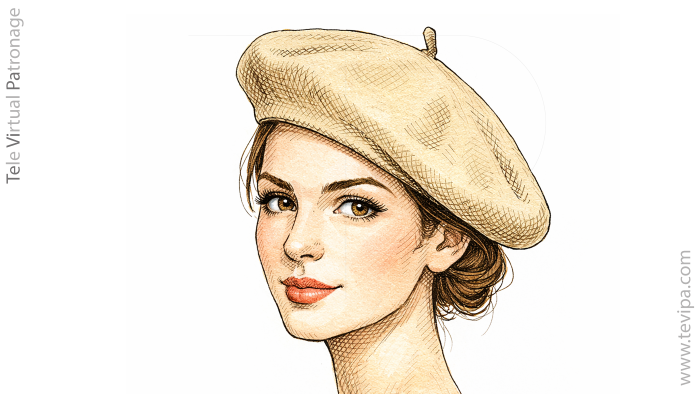
One of the most characteristic features of the beret is the small cord that appears at the centre of the upper crown.
This element, known in French as cabillou, originates from the traditional manufacturing process. Berets were initially knitted as a circular piece of wool that was closed in the centre with a small finishing knot of the yarn. When the garment was felted and shaped into the cap, that small end remained visible on the top.
Over time this detail ceased to be merely a technical consequence and became a distinctive feature of the beret, which many pieces still preserve even when it is no longer necessary.
From traditional object to geometric system
Despite its long history, the structure of the beret is surprisingly simple.
From a geometric point of view it can be described as the difference between two contours:
- an outer perimeter that defines the volume of the garment
- an inner opening that determines the fit on the head
This simplicity makes it possible to describe the beret through a parametric geometric system capable of adapting to different sizes, cranial proportions and design variants.
In the following sections we will analyse the elements that compose the beret and the variables necessary to construct its pattern accurately.
Structural description and nomenclature of the beret
For the purposes of this geometric system we distinguish the following parts.
The beret is a headwear garment composed of a circular upper element (crown plate) connected to an inner opening that defines the fitting perimeter on the head.
In its traditional construction it may be moulded in a single piece, usually of felt, whereas in flat patternmaking it is constructed through the joining of circular or elliptical surfaces.
For the purposes of this geometric system we distinguish the following elements.
Crown plate (P)
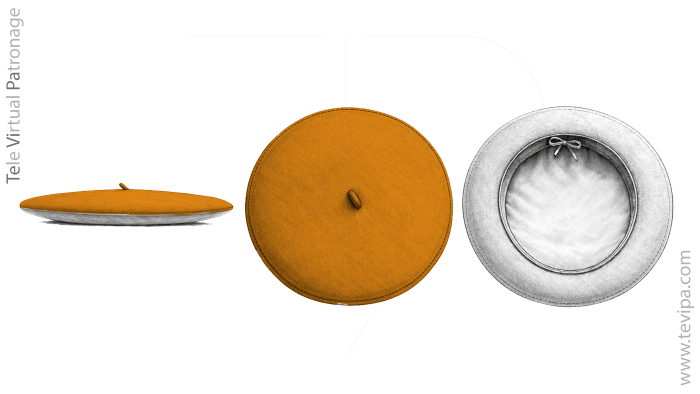
Upper element of the beret.
Shape: circular or elliptical.
It is defined by the outer radius (re) if it is circular, or by the major (l) and minor (w) axes in the case of an ellipse.
The crown plate determines the visual spread and the volume of the garment.
In sewn cloth berets it presents a perimeter seam along its edge.
Brim or spread (A)
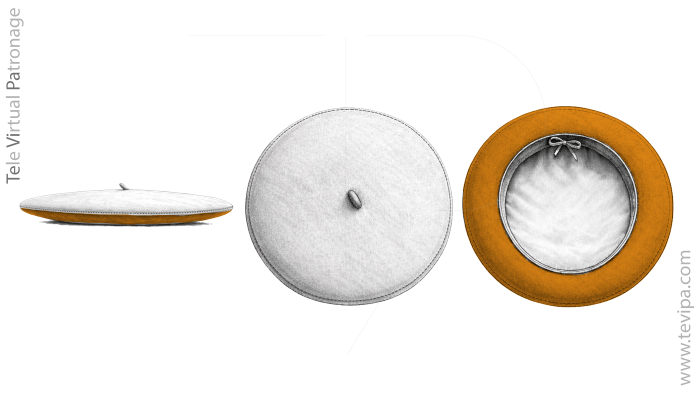
We define the brim as the piece that integrates the radial difference between the outer edge of the crown plate and the inner opening.
The inner opening is the aperture through which the beret fits onto the head.
It may be circular or elliptical.
The circular opening is defined by the theoretical radius (rt), while the elliptical opening is defined by the anteroposterior (l/2) and bilateral (w/2) semi-axes of the head.
The size of the beret is identified with the inner opening, which corresponds to the head circumference (k).
Sweatband
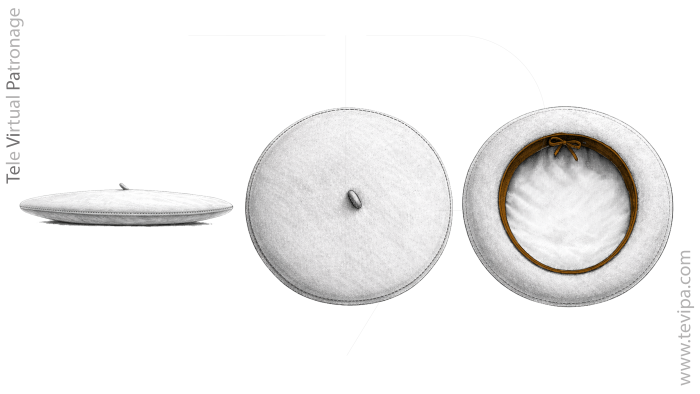
In garment making, millinery and leatherwork, the sweatband is a flexible band placed inside the beret that comes into contact with the head or skin, intended to absorb sweat and improve comfort.
It is also called the inner band or sweatband.
Traditionally the sweatband was made from fine leather, especially soft tanned sheepskin, which is very absorbent and comfortable.
By extension, the term is now also used for textile or synthetic bands performing the same function.
In many berets the sweatband may be made of cotton, polyester or technical fabrics, although the traditional name is still used.
Inside the sweatband we usually find the sweatband loop.
It is a small loop or tape tab, generally textile, located inside the beret and attached to the sweatband at the back of the garment.
Its main function is to indicate the rear position of the hat, facilitating its correct placement on the head.
Traditionally it is made with a narrow ribbon folded into a loop and sewn onto the inner band.
Besides its practical function, this element constitutes a traditional detail of millinery.muy suave y absorbente.
Beret lining
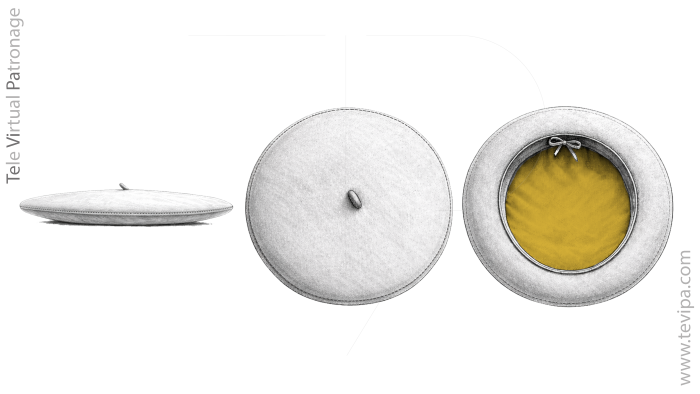
The lining of the beret is the inner layer of fabric that partially or completely covers the interior of the garment in order to hide the seams, protect the outer fabric and improve comfort in contact with the head.
It is attached to the garment by means of the sweatband, which holds the edge of the lining to the inner perimeter of the beret.
In addition to its protective function, the lining contributes to giving stability to the garment and improving its internal finish.
Only the crown plate may be lined, or both the crown plate and the brim.
Geometric typology of the beret
The beret can be classified according to its geometric and constructive structure.
From a technical point of view there are four main classification criteria.
According to the shape of the crown plate and the inner opening
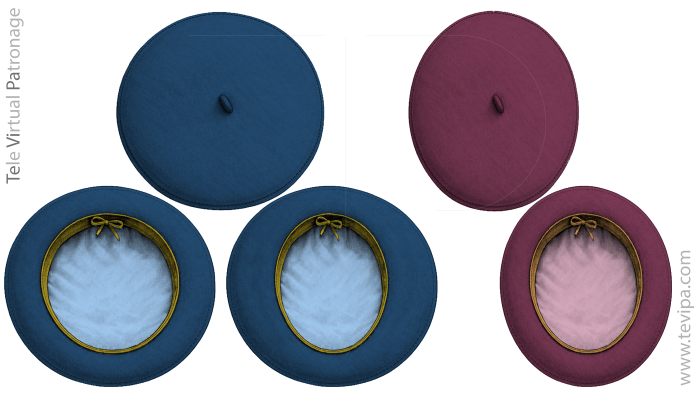
The crown plate may be:
Circular crown plate
The crown plate is a circumference.
This is the simplest and most traditional solution.
Elliptical crown plate
The crown plate adopts an elliptical shape, adapting better to cranial morphology when the ovality index is considered.
This allows for a more anthropometric garment.
The inner opening determines the fit on the head and constitutes the main structural element of the garment.
Circular opening
The inner contour is a circumference.
This is the simplest and most traditional solution.
Elliptical opening
The inner contour adopts the form of an ellipse, adapting better to cranial morphology when the ovality index is considered.
It allows a more anthropometric fit.
According to the position of the opening relative to the crown plate
The inner opening may be positioned in relation to the geometric centre of the outer crown plate.
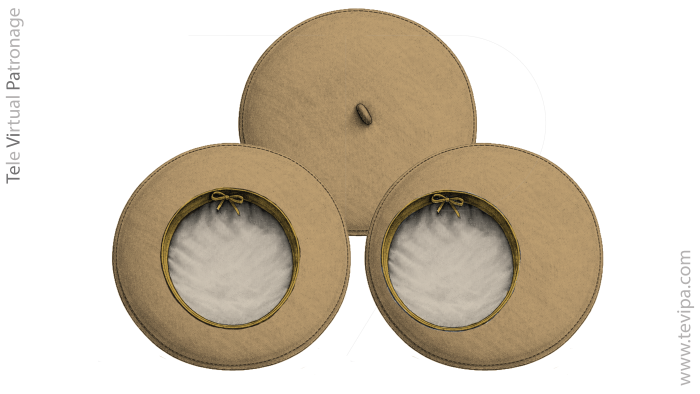
Concentric beret
The centre of the opening coincides with the centre of the crown plate.
Eccentric beret
The centre of the opening is displaced with respect to the centre of the crown plate.
This displacement may occur vertically, horizontally or in a combined direction, generating controlled drape and asymmetry effects.
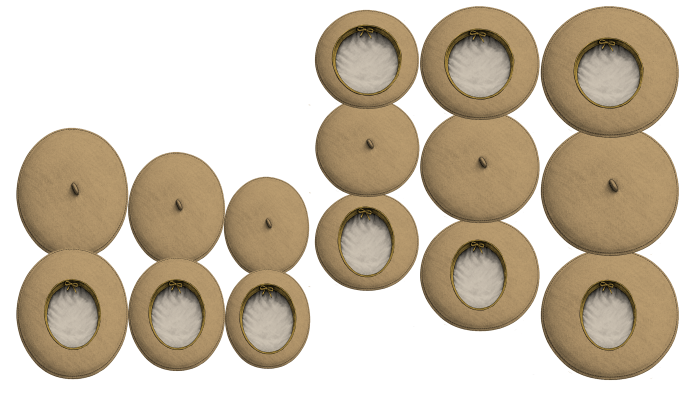
According to the width of the spread
The spread is the radial distance between the inner opening and the outer perimeter of the crown plate.
It may be classified as:
- narrow spread (tight beret)
- classic spread
- medium spread
- wide spread
The spread does not determine the fit of the garment, but rather the volumetric expression and the drape of the beret.
According to the internal adjustment system
The adjustment system can be implemented in several ways.
Without inner band: The opening is finished directly.
With concealed inner band: La cinta queda integrada en el interior y no es visible desde el exterior.
With visible inner band: The band becomes part of the design and may act as a decorative or structural element.
Structural conclusion
The combination of these four criteria allows the generation of a complete parametric system of berets adaptable to different cranial morphologies, styles and ages, while maintaining a coherent geometric basis.
Geometric centre of the crown plate (cp)
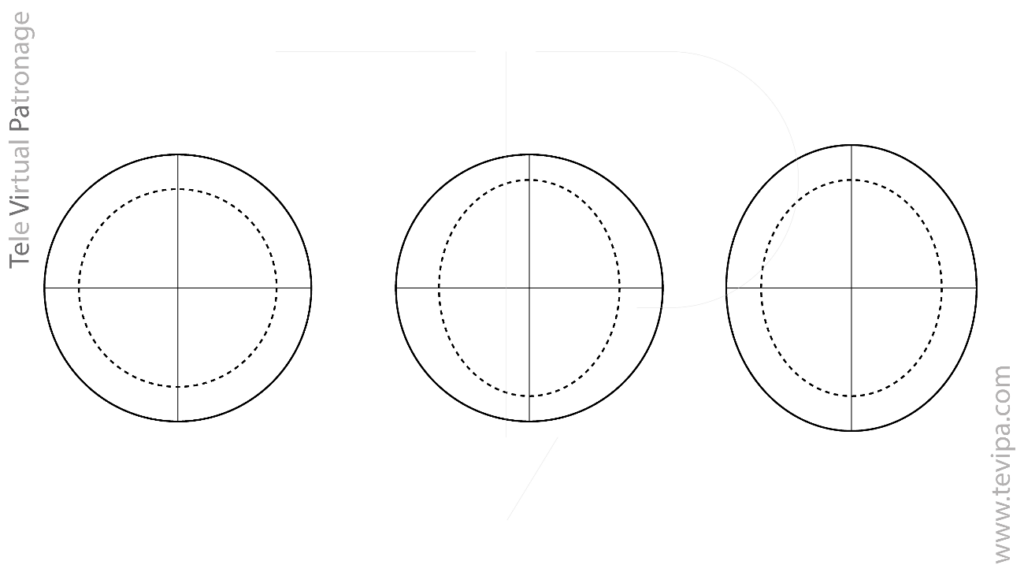
Centre of the crown plate.
In the classic model, the centre of the crown plate (cp) coincides with the centre of the inner opening.
In an offset variant, the centre of the crown plate (cp) is displaced by a distance (d) relative to the centre of the opening, generating directional drape.
Centre of the opening (ch)
Geometric centre of the inner perimeter.
Defines the structural fitting point on the head.
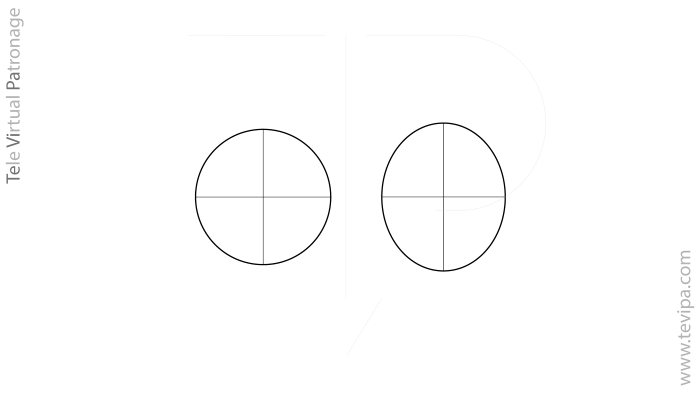
Offset (d)
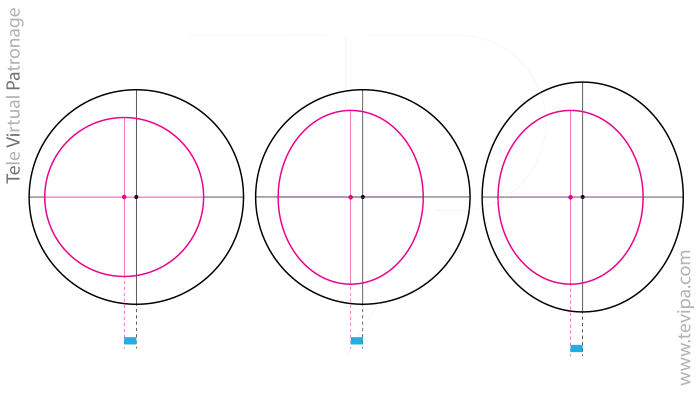
The centre offset, or eccentricity, is the distance between the centre of the crown plate (cp) and the centre of the opening (ch).
In the previous illustration the centre offset has been marked with a thick blue line.
When the beret is not concentric (when d ≠ 0), the beret presents an irregular spread.
Structural variants
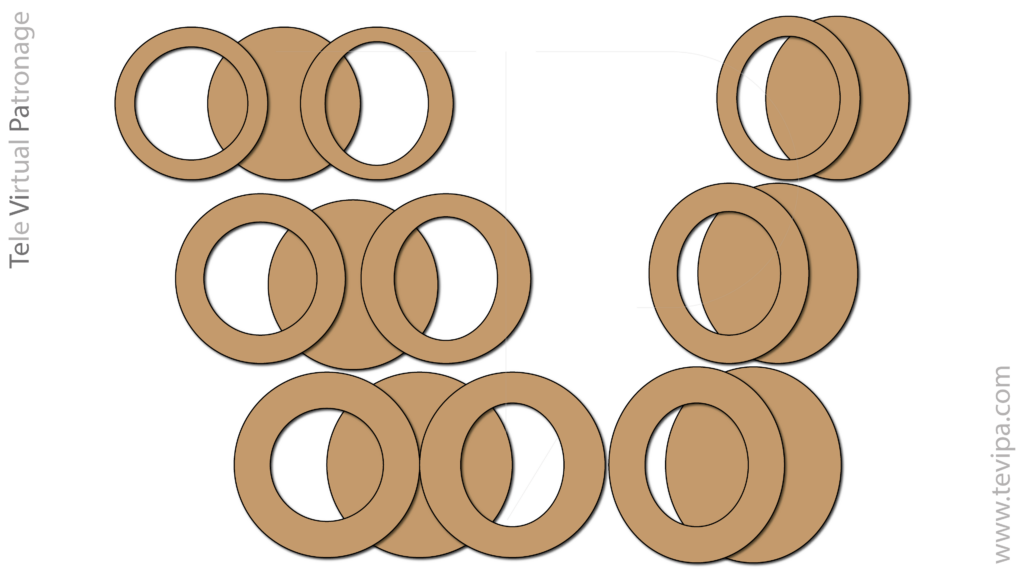
According to geometric combination:
- concentric circular
- offset circular
- centred elliptical
- offset elliptical
Each one produces a different volumetric behaviour.
Table and variables
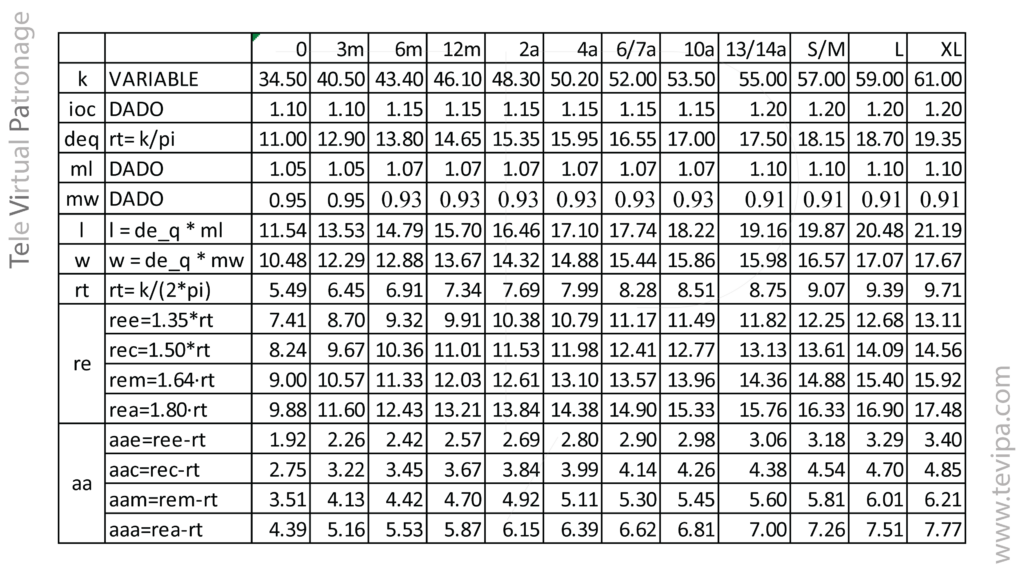
k: head circumference
ioc: cranial ovality index
deq: equivalent diameter
ml: anteroposterior cranial multiplier
mw: bilateral cranial multiplier
l: anteroposterior cranial diameter
w: bilateral cranial diameter
rt: theoretical head radius
ree: outer radius for tight beret
rec: outer radius for classic beret
rem: outer radius for medium beret
rea: outer radius for wide beret
aae: brim width of tight beret
aac: brim width of classic beret
aam: brim width of medium beret
aaa: brim width of wide beret
In this section we define precisely all the variables used for the calculation and construction of the beret.
Each symbol, each formula and each designation responds to a specific and reproducible function.
The objective is that once the terms and their relationships are understood, the system can be used autonomously for any head size, from baby to adult XL, and adapted to circular or elliptical construction variants.
Below are the variables used in the system, with their description, type and formula where applicable.
Head circumference (k)
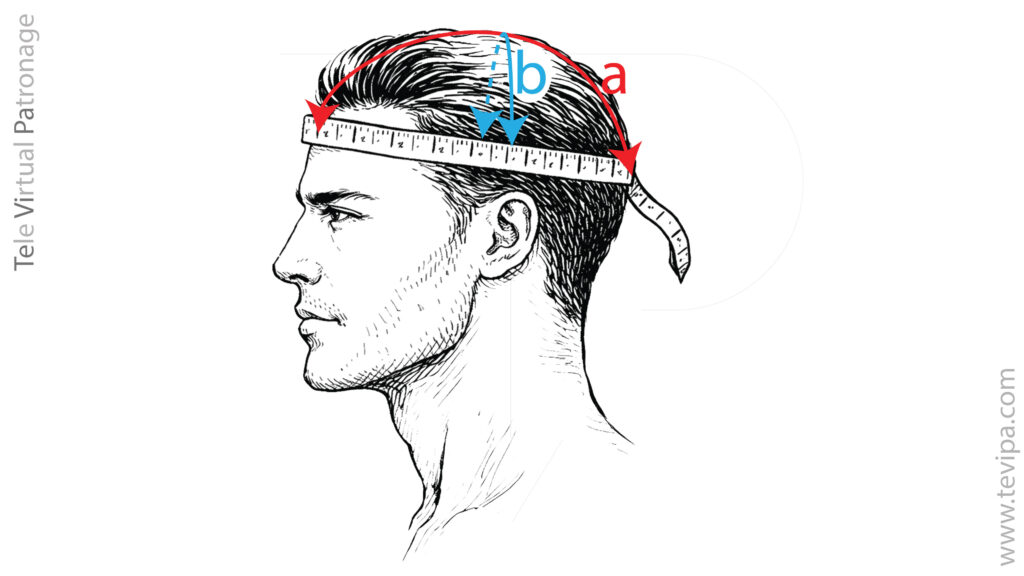
This is the real circumference of the head measured with a flexible measuring tape, taken along the support area of the beret (forehead and occipital area).
This measurement is the basis of the garment.
All other measurements derive from it.
Cranial ovality index (ioc)
The cranial ovality index expresses how far the shape of the head deviates from a perfect circle when represented as an ellipse.
It is defined as:
ioc = anteroposterior diameter / bilateral diameter
The anteroposterior diameter corresponds to the distance between the forehead and the most prominent point at the back of the head.
The bilateral diameter corresponds to the distance between both sides of the skull, taken from ear to ear.
This index is used to transform the dimensions of a circle into an ellipse when an elliptical variant is used.
Equivalent diameter (deq)
Diameter of the circle equivalent to the measured head circumference.
It serves as a base measurement for deriving other proportions.
Anteroposterior cranial diameter multiplier (ml)
Coefficient used to estimate the anteroposterior cranial axis from the equivalent diameter. Calculated from external anthropometric databases.
Bilateral cranial diameter multiplier (mw)
Coefficient used to estimate the lateral (bilateral) cranial axis from the equivalent diameter. Calculated from external anthropometric databases.
Anteroposterior cranial diameter (l)
Estimation of the head diameter along the anteroposterior axis, used when calculating the elliptical inner opening.
Bilateral cranial diameter (w)
Estimation of the head diameter along the lateral axis, used for the elliptical opening.
Theoretical head radius (rt)
Radius of the circle equivalent to the head circumference. It is the base used to calculate inner and outer radii.
It corresponds to half of the equivalent diameters.
Beret outer radius index (ire)
We define four values depending on the desired spread of the beret.
In all cases the theoretical head radius is multiplied by the suggested index.
These values function as guidelines to achieve the correct shape of the beret.
The indices are calibrated from proportions observed in industrial berets and adapted to a clear and scalable parametric system.
To obtain the outer radius (re) of a beret we multiply the outer radius index (ire) by the theoretical head radius.
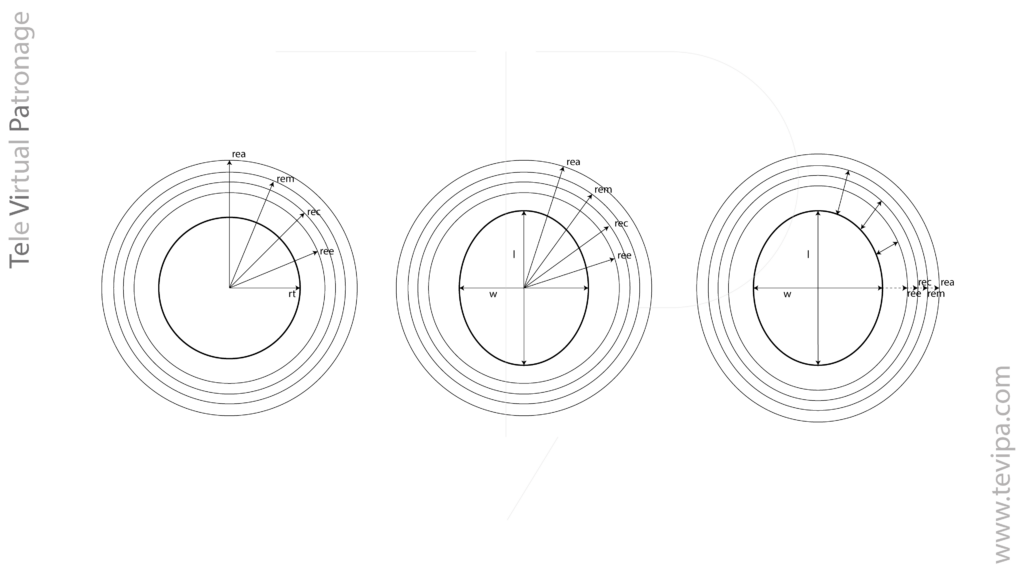
The following indices are established:
Outer radius index for tight beret: 1.35
Outer radius index for classic beret: 1.50
Outer radius index for medium beret: 1.64
Outer radius index for wide beret: 1.80
The “rag” of the beret
Custom pattern